

Jan-2025 Latest PremiumVCEDump Professional-Machine-Learning-Engineer Exam Dumps with PDF and Exam Engine Free Updated Today!
Following are some new Professional-Machine-Learning-Engineer Real Exam Questions!
NEW QUESTION # 29
You are going to train a DNN regression model with Keras APIs using this code: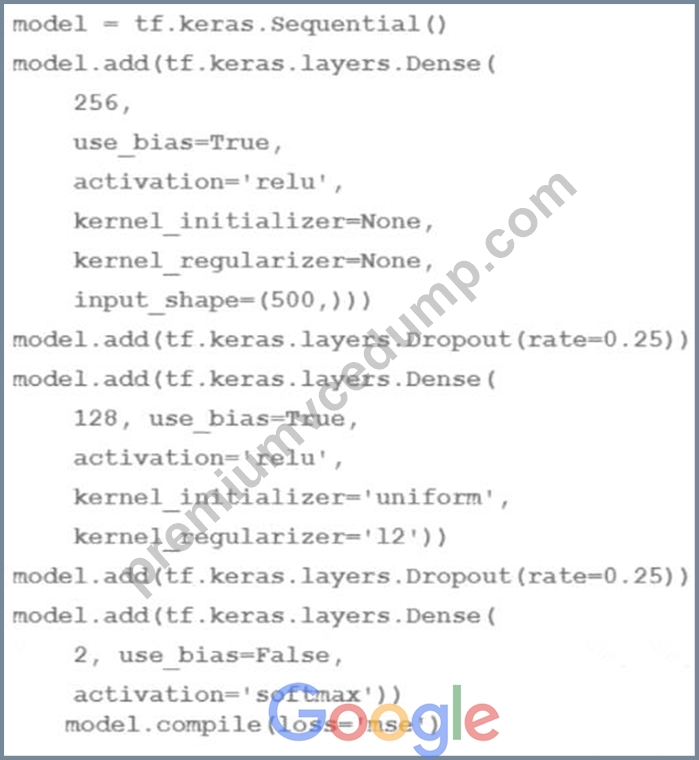
How many trainable weights does your model have? (The arithmetic below is correct.)
- A. 501*256+257*128+128*2=161408
- B. 500*256*0 25+256*128*0 25+128*2 = 40448
- C. 501*256+257*128+2 = 161154
- D. 500*256+256*128+128*2 = 161024
Answer: D
Explanation:
The number of trainable weights in a DNN regression model with Keras APIs can be calculated by multiplying the number of input units by the number of output units for each layer, and adding the number of bias units for each layer. The bias units are usually equal to the number of output units,except for the last layer, which does not have bias units if the activation function is softmax1. In this code, the model has three layers: a dense layer with 256 units and relu activation, a dropout layer with 0.25 rate, and a dense layer with 2 units and softmax activation. The input shape is 500. Therefore, the number of trainable weights is:
* For the first layer: 500 input units * 256 output units + 256 bias units = 128256
* For the second layer: The dropout layer does not have any trainable weights, as it only randomly sets some of the input units to zero to prevent overfitting2.
* For the third layer: 256 input units * 2 output units + 0 bias units = 512 The total number of trainable weights is 128256 + 512 = 161024. Therefore, the correct answer is B.
References:
* How to calculate the number of parameters for a Convolutional Neural Network?
* Dropout (keras.io)
NEW QUESTION # 30
You work for a gaming company that manages a popular online multiplayer game where teams with 6 players play against each other in 5-minute battles. There are many new players every day. You need to build a model that automatically assigns available players to teams in real time. User research indicates that the game is more enjoyable when battles have players with similar skill levels. Which business metrics should you track to measure your model's performance? (Choose One Correct Answer)
- A. Rate of return as measured by additional revenue generated minus the cost of developing a new model
- B. Average time players wait before being assigned to a team
- C. User engagement as measured by the number of battles played daily per user
- D. Precision and recall of assigning players to teams based on their predicted versus actual ability
Answer: C
NEW QUESTION # 31
You work for a company that captures live video footage of checkout areas in their retail stores You need to use the live video footage to build a mode! to detect the number of customers waiting for service in near real time You want to implement a solution quickly and with minimal effort How should you build the model?
- A. Train an AutoML object detection model on an annotated dataset by using Vertex AutoML
- B. Train a Seq2Seq+ object detection model on an annotated dataset by using Vertex AutoML
- C. Use the Vertex Al Vision Occupancy Analytics model.
- D. Use the Vertex Al Vision Person/vehicle detector model
Answer: C
Explanation:
According to the official exam guide1, one of the skills assessed in the exam is to "design, build, and productionalize ML models to solve business challenges using Google Cloud technologies". The Vertex AI Vision Occupancy Analytics model2 is a specialized pre-built vision model that lets you count people or vehicles given specific inputs you add in video frames. It provides advanced features such as active zones counting, line crossing counting, and dwelling detection. This model is suitable for the use case of detecting the number of customers waiting for service in near real time. You can easily create and deploy an occupancy analytics application using Vertex AI Vision3. The other options are not relevant or optimal for this scenario.
References:
* Professional ML Engineer Exam Guide
* Occupancy analytics guide
* Create an occupancy analytics app with BigQuery forecasting
* Google Professional Machine Learning Certification Exam 2023
* Latest Google Professional Machine Learning Engineer Actual Free Exam Questions
NEW QUESTION # 32
You have been given a dataset with sales predictions based on your company's marketing activities. The data is structured and stored in BigQuery, and has been carefully managed by a team of data analysts. You need to prepare a report providing insights into the predictive capabilities of the data. You were asked to run several ML models with different levels of sophistication, including simple models and multilayered neural networks.
You only have a few hours to gather the results of your experiments. Which Google Cloud tools should you use to complete this task in the most efficient and self-serviced way?
- A. Read the data from BigQuery using Dataproc, and run several models using SparkML.
- B. Train a custom TensorFlow model with Vertex AI, reading the data from BigQuery featuring a variety of ML algorithms.
- C. Use Vertex AI Workbench user-managed notebooks with scikit-learn code for a variety of ML algorithms and performance metrics.
- D. Use BigQuery ML to run several regression models, and analyze their performance.
Answer: D
Explanation:
* Option A is correct because using BigQuery ML to run several regression models, and analyze their performance is the most efficient and self-serviced way to complete the task. BigQuery ML is a service that allows you to create and use ML models within BigQuery using SQL queries1. You can use BigQuery ML to run different types of regression models, such as linear regression, logistic regression, or DNN regression2. You can also use BigQuery ML to analyzethe performance of your models, such as the mean squared error, the accuracy, or the ROC curve3. BigQuery ML is fast, scalable, and easy to use, as it does not require any data movement, coding, or additional tools4.
* Option B is incorrect because reading the data from BigQuery using Dataproc, and running several models using SparkML is not the most efficient and self-serviced way to complete the task. Dataproc is a service that allows you to create and manage clusters of virtual machinesthat run Apache Spark and other open-source tools5. SparkML is a library that provides ML algorithms and utilities for Spark.
However, this option requires more effort and resources than option A, as it involves moving the data from BigQuery to Dataproc, creating and configuring the clusters, writing and running the SparkML code, and analyzing the results.
* Option C is incorrect because using Vertex AI Workbench user-managed notebooks with scikit-learn code for a variety of ML algorithms and performance metrics is not the most efficient and self-serviced way to complete the task. Vertex AI Workbench is a service that allows you to create and use notebooks for ML development and experimentation. Scikit-learn is a library that provides ML algorithms and utilities for Python. However, this option also requires more effort and resources than option A, as it involves creating and managing the notebooks, writing and running the scikit-learn code, and analyzing the results.
* Option D is incorrect because training a custom TensorFlow model with Vertex AI, reading the data from BigQuery featuring a variety of ML algorithms is not the most efficient and self-serviced way to complete the task. TensorFlow is a framework that allows you to create and train ML models using Python or other languages. Vertex AI is a service that allows you to train and deploy ML models using built-in algorithms or custom containers. However, this option also requires more effort and resources than option A, as it involves writing and running the TensorFlow code, creating and managing the training jobs, and analyzing the results.
References:
* BigQuery ML overview
* Creating a model in BigQuery ML
* Evaluating a model in BigQuery ML
* BigQuery ML benefits
* Dataproc overview
* [SparkML overview]
* [Vertex AI Workbench overview]
* [Scikit-learn overview]
* [TensorFlow overview]
* [Vertex AI overview]
NEW QUESTION # 33
You work for a retail company. You have a managed tabular dataset in Vertex Al that contains sales data from three different stores. The dataset includes several features such as store name and sale timestamp. You want to use the data to train a model that makes sales predictions for a new store that will open soon You need to split the data between the training, validation, and test sets What approach should you use to split the data?
- A. Use Vertex Al chronological split and specify the sales timestamp feature as the time vanable.
- B. Use Vertex Al manual split, using the store name feature to assign one store for each set.
- C. Use Vertex Al default data split.
- D. Use Vertex Al random split assigning 70% of the rows to the training set, 10% to the validation set, and
20% to the test set.
Answer: C
Explanation:
The best option for splitting the data between the training, validation, and test sets, using a managed tabular dataset in Vertex AI that contains sales data from three different stores, is to use Vertex AI default data split.
This option allows you to leverage the power and simplicity of Vertex AI to automatically and randomly split your data into the three sets by percentage. Vertex AI is a unified platform for building and deploying machine learning solutions on Google Cloud. Vertex AI can support various types of models, such as linear regression, logistic regression, k-means clustering, matrix factorization, and deep neural networks. Vertex AI can also provide various tools and services for data analysis, model development, model deployment, model monitoring, and model governance. A default data split is a data split method that is provided by Vertex AI, and does not require any user input or configuration. A default data split can help you split your data into the training, validation, and test sets by using a random sampling method, and assign a fixed percentage of the data to each set. A default data split can help you simplify the data split process, and works well in most cases.
A training set is a subset of the data that is used to train the model, and adjust the model parameters. A training set can help you learn the relationship between the input features and the target variable, and optimize the model performance. A validation set is a subset of the data that is used to validate the model, and tune the model hyperparameters. A validation set can help you evaluate the model performance on unseen data, and avoid overfitting or underfitting. A test set is a subset of the datathat is used to test the model, and provide the final evaluation metrics. A test set can help you assess the model performance on new data, and measure the generalization ability of the model. By using Vertex AI default data split, you can split your data into the training, validation, and test sets by using a random sampling method, and assign the following percentages of the data to each set1:
The other options are not as good as option B, for the following reasons:
* Option A: Using Vertex AI manual split, using the store name feature to assign one store for each set would not allow you to split your data into representative and balanced sets, and could cause errors or poor performance. A manual split is a data split method that allows you to control how your data is split into sets, by using the ml_use label or the data filter expression. A manual split can help you customize the data split logic, and handle complex or non-standard data formats. A store name feature is a feature that indicates the name of the store where the sales data was collected. A store name feature can help you identify the source of the data, and group the data by store. However, using Vertex AI manual split, using the store name feature to assign one store for each set would not allow you to split your data into representative and balanced sets, and could cause errors or poor performance. You would need to write code, create and configure the ml_use label or the data filter expression, and assign one store for each set. Moreover, this option would not ensure that the data in each set has the same distribution and characteristics as the data in the whole dataset, which could prevent you from learning the general pattern of the data, and cause bias or variance in the model2.
* Option C: Using Vertex AI chronological split and specifying the sales timestamp feature as the time variable would not allow you to split your data into representative and balanced sets, and could cause errors or poor performance. A chronological split is a data split method that allows you to split your data into sets based on the order of the data. A chronological split can help you preserve the temporal dependency and sequence of the data, and avoid data leakage. A sales timestamp feature is a feature that indicates the date and time when the sales data was collected. A sales timestamp feature can help you track the changes and trends of the data over time, and capture the seasonality and cyclicality of the data. However, using Vertex AI chronological split and specifying the sales timestamp feature as the time variable would not allow you to split your data into representative and balanced sets, and could cause errors or poor performance. You would need to write code, create and configure the time variable, and split the data by the order of the time variable. Moreover, this option would not ensure that the data in each set has the same distribution and characteristics as the data in the whole dataset, which could prevent you from learning the general pattern of the data, and cause bias or variance in the model3.
* Option D: Using Vertex AI random split, assigning 70% of the rows to the training set, 10% to the validation set, and 20% to the test set would not allow you to use the default data splitmethod that is provided by Vertex AI, and could increase the complexity and cost of the data split process. A random split is a data split method that allows you to split your data into sets by using a random sampling method, and assign a custom percentage of the data to each set. A random split can help you split your data into representative and balanced sets, and avoid data leakage. However, using Vertex AI random split, assigning 70% of the rows to the training set, 10% to the validation set, and 20% to the test set would not allow you to use the default data split method that is provided by Vertex AI, and could increase the complexity and cost of the data split process. You would need to write code, create and configure the random split method, and assign the custom percentages to each set. Moreover, this option would not use the default data split method that is provided by Vertex AI, which can simplify the data split process, and works well in most cases1.
References:
* About data splits for AutoML models | Vertex AI | Google Cloud
* Manual split for unstructured data
* Mathematical split
NEW QUESTION # 34
You are training a Resnet model on Al Platform using TPUs to visually categorize types of defects in automobile engines. You capture the training profile using the Cloud TPU profiler plugin and observe that it is highly input-bound. You want to reduce the bottleneck and speed up your model training process. Which modifications should you make to the tf .data dataset?
Choose 2 answers
- A. Increase the buffer size for the shuffle option.
- B. Use the interleave option for reading data
- C. Decrease the batch size argument in your transformation
- D. Set the prefetch option equal to the training batch size
- E. Reduce the value of the repeat parameter
Answer: B,D
Explanation:
The tf.data dataset is a TensorFlow API that provides a way to create and manipulate data pipelines for machine learning. The tf.data dataset allows you to apply various transformations to the data, such as reading, shuffling, batching, prefetching, and interleaving. These transformations can affect the performance and efficiency of the model training process1 One of the common performance issues in model training is input-bound, which means that the model is waiting for the input data to be ready and is not fully utilizing the computational resources. Input-bound can be caused by slow data loading, insufficient parallelism, or large data size. Input-bound can be detected by using the Cloud TPU profiler plugin, which is a tool that helps you analyze the performance of your model on Cloud TPUs. The Cloud TPU profiler plugin can show you the percentage of time that the TPU cores are idle, which indicates input-bound2 To reduce the input-bound bottleneck and speed up the model training process, you can make some modifications to the tf.data dataset. Two of the modifications that can help are:
* Use the interleave option for reading data. The interleave option allows you to read data from multiple files in parallel and interleave their records. This can improve the data loading speed and reduce the idle time of the TPU cores. The interleave option can be applied by using the tf.data.Dataset.interleave method, which takes a function that returns a dataset for each input element, and a number of parallel calls3
* Set the prefetch option equal to the training batch size. The prefetch option allows you to prefetch the next batch of data while the current batch is being processed by the model. This can reduce the latency
* between batches and improve the throughput of the model training. The prefetch option can be applied by using the tf.data.Dataset.prefetch method, which takes a buffer size argument. The buffer size should be equal to the training batch size, which is the number of examples per batch4 The other options are not effective or counterproductive. Reducing the value of the repeat parameter will reduce the number of epochs, which is the number of times the model sees the entire dataset. This can affect the model's accuracy and convergence. Increasing the buffer size for the shuffle option will increase the randomness of the data, but also increase the memory usage and the data loading time. Decreasing the batch size argument in your transformation will reduce the number of examples per batch, which can affect the model's stability and performance.
References: 1: tf.data: Build TensorFlow input pipelines 2: Cloud TPU Tools in TensorBoard 3: tf.data.Dataset.interleave 4: tf.data.Dataset.prefetch : [Better performance with the tf.data API]
NEW QUESTION # 35
You recently used XGBoost to train a model in Python that will be used for online serving Your model prediction service will be called by a backend service implemented in Golang running on a Google Kubemetes Engine (GKE) cluster Your model requires pre and postprocessing steps You need to implement the processing steps so that they run at serving time You want to minimize code changes and infrastructure maintenance and deploy your model into production as quickly as possible. What should you do?
- A. Use the Predictor interface to implement a custom prediction routine Build the custom contain upload the container to Vertex Al Model Registry, and deploy it to a Vertex Al endpoint.
- B. Use FastAPI to implement an HTTP server Create a Docker image that runs your HTTP server Upload the image to Vertex Al Model Registry and deploy it to a Vertex Al endpoint.
- C. Use the XGBoost prebuilt serving container when importing the trained model into Vertex Al Deploy the model to a Vertex Al endpoint Work with the backend engineers to implement the pre- and postprocessing steps in the Golang backend service.
- D. Use FastAPI to implement an HTTP server Create a Docker image that runs your HTTP server and deploy it on your organization's GKE cluster.
Answer: A
Explanation:
The best option for implementing the processing steps so that they run at serving time, minimizing code changes and infrastructure maintenance, and deploying the model into production as quickly as possible, is to use the Predictor interface to implement a custom prediction routine. Build the custom container, upload the container to Vertex AI Model Registry, and deploy it to a Vertex AI endpoint. This option allows you to leverage the power and simplicity of Vertex AI to serve your XGBoost model with minimal effort and customization. Vertex AI is a unified platform for building and deploying machine learning solutions on Google Cloud. Vertex AI can deploy a trained XGBoost model to an online prediction endpoint, which can provide low-latency predictions for individual instances. A custom prediction routine (CPR) is a Python script that defines the logic for preprocessing the input data, running the prediction, and postprocessing the output data. A CPR can help you customize the prediction behavior of your model, and handle complex or non-standard data formats. A CPR can also help you minimize the code changes, as you only need to write a few functions to implement the prediction logic. A Predictor interface is a class that inherits from the base class aiplatform.Predictor, and implements the abstract methods predict() and preprocess(). A Predictor interface can help you create a CPR by defining the preprocessing and prediction logic for your model. A container image is a package that contains the model, the CPR, and the dependencies. A container image can help you standardize and simplify the deployment process, as you only need to upload the container image to Vertex AI Model Registry, and deploy it to Vertex AI Endpoints. By using the Predictor interface to implement a CPR, building the custom container, uploading the container to Vertex AI Model Registry, and deploying it to a Vertex AI endpoint, you can implement the processing steps so that they run at serving time, minimize code changes and infrastructure maintenance, and deploy the model into production as quickly as possible1.
The other options are not as good as option C, for the following reasons:
* Option A: Using FastAPI to implement an HTTP server, creating a Docker image that runs your HTTP server, and deploying it on your organization's GKE cluster would require more skills and steps than using the Predictor interface to implement a CPR, building the custom container, uploading the container to Vertex AI Model Registry, and deploying it to a Vertex AI endpoint. FastAPI is a framework for building web applications and APIs in Python. FastAPI can help you implement an HTTP server that can handle prediction requests and responses, and perform data preprocessing and postprocessing. A Docker image is a package that contains the model, the HTTP server, and the
* dependencies. A Docker image can help you standardize and simplify the deployment process, as you only need to build and run the Docker image. GKE is a service that can create and manage Kubernetes clusters on Google Cloud. GKE can help you deploy and scale your Docker image on Google Cloud, and provide high availability and performance. However, using FastAPI to implement an HTTP server, creating a Docker image that runs your HTTP server, and deploying it on your organization's GKE cluster would require more skills and steps than using the Predictor interface to implement a CPR, building the custom container, uploading the container to Vertex AI Model Registry, and deploying it to a Vertex AI endpoint. You would need to write code, create and configure the HTTP server, build and test the Docker image, create and manage the GKE cluster, and deploy and monitor the Docker image. Moreover, this option would not leverage the power and simplicity of Vertex AI, which can provide online prediction natively integrated with Google Cloud services2.
* Option B: Using FastAPI to implement an HTTP server, creating a Docker image that runs your HTTP server, uploading the image to Vertex AI Model Registry, and deploying it to a Vertex AI endpoint would require more skills and steps than using the Predictor interface to implement a CPR, building the custom container, uploading the container to Vertex AI Model Registry, and deploying it to a Vertex AI endpoint. FastAPI is a framework for building web applications and APIs in Python. FastAPI can help you implement an HTTP server that can handle prediction requests and responses, and perform data preprocessing and postprocessing. A Docker image is a package that contains the model, the HTTP server, and the dependencies. A Docker image can help you standardize and simplify the deployment process, as you only need to build and run the Docker image. Vertex AI Model Registry is a service that can store and manage your machine learning models on Google Cloud. Vertex AI Model Registry can help you upload and organize your Docker image, and track the model versions and metadata. Vertex AI Endpoints is a service that can provide online prediction for your machine learning models on Google Cloud. Vertex AI Endpoints can help you deploy your Docker image to an online prediction endpoint, which can provide low-latency predictions for individual instances. However, using FastAPI to implement an HTTP server, creating a Docker image that runs your HTTP server, uploading the image to Vertex AI Model Registry, and deploying it to a Vertex AI endpoint would require more skills and steps than using the Predictor interface to implement a CPR, building the custom container, uploading the container to Vertex AI Model Registry, and deploying it to a Vertex AI endpoint. You would need to write code, create and configure the HTTP server, build and test the Docker image, upload the Docker image to Vertex AI Model Registry, and deploy the Docker image to Vertex AI Endpoints. Moreover, this option would not leverage the power and simplicity of Vertex AI, which can provide online prediction natively integrated with Google Cloud services2.
* Option D: Using the XGBoost prebuilt serving container when importing the trained model into Vertex AI, deploying the model to a Vertex AI endpoint, working with the backend engineers to implement the pre- and postprocessing steps in the Golang backend service would not allow you to implement the processing steps so that they run at serving time, and could increase the code changes and infrastructure maintenance. A XGBoost prebuilt serving container is a container image that is provided by Google Cloud, and contains the XGBoost framework and the dependencies. A XGBoost prebuilt serving container can help you deploy a XGBoost model without writing any code, but it also limits your customization options. A XGBoost prebuilt serving container can only handle standard data formats, such as JSON or CSV, and cannot perform any preprocessing or postprocessing on the input or output data. If your input data requires any transformation or normalization before running the prediction, you cannot use a XGBoost prebuilt serving container. A Golang backend service is a service that is implemented in Golang, a programming language that can be used for web development and system programming. A Golang backend service can help you handle the prediction requests and responses from the frontend, and communicate with the Vertex AI endpoint. However, using the XGBoost prebuilt serving container when importing the trained model into Vertex AI, deploying the model to a Vertex AI endpoint, working with the backend engineers to implement the pre- and postprocessing steps in the
* Golang backend service would not allow you to implement the processing steps so that they run at serving time, and could increase the code changes and infrastructure maintenance. You would need to write code, import the trained model into Vertex AI, deploy the model to a Vertex AI endpoint, implement the pre- and postprocessing steps in the Golang backend service, and test and monitor the Golang backend service. Moreover, this option would not leverage the power and simplicity of Vertex AI, which can provide online prediction natively integrated with Google Cloud services2.
References:
* Preparing for Google Cloud Certification: Machine Learning Engineer, Course 3: Production ML Systems, Week 2: Serving ML Predictions
* Google Cloud Professional Machine Learning Engineer Exam Guide, Section 3: Scaling ML models in production, 3.1 Deploying ML models to production
* Official Google Cloud Certified Professional Machine Learning Engineer Study Guide, Chapter 6:
Production ML Systems, Section 6.2: Serving ML Predictions
* Custom prediction routines
* Using pre-built containers for prediction
* Using custom containers for prediction
NEW QUESTION # 36
You are designing an ML recommendation model for shoppers on your company's ecommerce website. You will use Recommendations Al to build, test, and deploy your system. How should you develop recommendations that increase revenue while following best practices?
- A. Import your user events and then your product catalog to make sure you have the highest quality event stream
- B. Use the "Other Products You May Like" recommendation type to increase the click-through rate
- C. Because it will take time to collect and record product data, use placeholder values for the product catalog to test the viability of the model.
- D. Use the "Frequently Bought Together' recommendation type to increase the shopping cart size for each order.
Answer: A
NEW QUESTION # 37
A gaming company has launched an online game where people can start playing for free, but they need to pay if they choose to use certain features. The company needs to build an automated system to predict whether or not a new user will become a paid user within 1 year. The company has gathered a labeled dataset from 1 million users.
The training dataset consists of 1,000 positive samples (from users who ended up paying within 1 year) and
999,000 negative samples (from users who did not use any paid features). Each data sample consists of 200 features including user age, device, location, and play patterns.
Using this dataset for training, the Data Science team trained a random forest model that converged with over
99% accuracy on the training set. However, the prediction results on a test dataset were not satisfactory Which of the following approaches should the Data Science team take to mitigate this issue? (Choose two.)
- A. Generate more positive samples by duplicating the positive samples and adding a small amount of noise to the duplicated data.
- B. Add more deep trees to the random forest to enable the model to learn more features.
- C. Change the cost function so that false negatives have a higher impact on the cost value than false positives.
- D. Include a copy of the samples in the test dataset in the training dataset.
- E. Change the cost function so that false positives have a higher impact on the cost value than false negatives.
Answer: A,C
NEW QUESTION # 38
You are training a Resnet model on Al Platform using TPUs to visually categorize types of defects in automobile engines. You capture the training profile using the Cloud TPU profiler plugin and observe that it is highly input-bound. You want to reduce the bottleneck and speed up your model training process. Which modifications should you make to the tf .data dataset?
Choose 2 answers
- A. Increase the buffer size for the shuffle option.
- B. Use the interleave option for reading data
- C. Decrease the batch size argument in your transformation
- D. Set the prefetch option equal to the training batch size
- E. Reduce the value of the repeat parameter
Answer: B,D
Explanation:
The tf.data dataset is a TensorFlow API that provides a way to create and manipulate data pipelines for machine learning. The tf.data dataset allows you to apply various transformations to the data, such as reading, shuffling, batching, prefetching, and interleaving. These transformations can affect the performance and efficiency of the model training process1 One of the common performance issues in model training is input-bound, which means that the model is waiting for the input data to be ready and is not fully utilizing the computational resources. Input-bound can be caused by slow data loading, insufficient parallelism, or large data size. Input-bound can be detected by using the Cloud TPU profiler plugin, which is a tool that helps you analyze the performance of your model on Cloud TPUs. The Cloud TPU profiler plugin can show you the percentage of time that the TPU cores are idle, which indicates input-bound2 To reduce the input-bound bottleneck and speed up the model training process, you can make some modifications to the tf.data dataset. Two of the modifications that can help are:
* Use the interleave option for reading data. The interleave option allows you to read data from multiple files in parallel and interleave their records. This can improve the data loading speed and reduce the idle
* time of the TPU cores. The interleave option can be applied by using
the tf.data.Dataset.interleave method, which takes a function that returns a dataset for each input element, and a number of parallel calls3
* Set the prefetch option equal to the training batch size. The prefetch option allows you to prefetch the next batch of data while the current batch is being processed by the model. This can reduce the latency between batches and improve the throughput of the model training. The prefetch option can be applied by using the tf.data.Dataset.prefetch method, which takes a buffer size argument. The buffer size should be equal to the training batch size, which is the number of examples per batch4 The other options are not effective or counterproductive. Reducing the value of the repeat parameter will reduce the number of epochs, which is the number of times the model sees the entire dataset. This can affect the model's accuracy and convergence. Increasing the buffer size for the shuffle option will increase the randomness of the data, but also increase the memory usage and the data loading time. Decreasing the batch size argument in your transformation will reduce the number of examples per batch, which can affect the model's stability and performance.
References: 1: tf.data: Build TensorFlow input pipelines 2: Cloud TPU Tools in TensorBoard 3: tf.data.Dataset.interleave 4: tf.data.Dataset.prefetch : [Better performance with the tf.data API]
NEW QUESTION # 39
Your company manages an application that aggregates news articles from many different online sources and sends them to users. You need to build a recommendation model that will suggest articles to readers that are similar to the articles they are currently reading. Which approach should you use?
- A. Create a collaborative filtering system that recommends articles to a user based on the user's past behavior.
- B. Manually label a few hundred articles, and then train an SVM classifier based on the manually classified articles that categorizes additional articles into their respective categories.
- C. Encode all articles into vectors using word2vec, and build a model that returns articles based on vector similarity.
- D. Build a logistic regression model for each user that predicts whether an article should be recommended to a user.
Answer: A
NEW QUESTION # 40
You are an ML engineer at a manufacturing company. You need to build a model that identifies defects in products based on images of the product taken at the end of the assembly line. You want your model to preprocess the images with lower computation to quickly extract features of defects in products. Which approach should you use to build the model?
- A. Recommender system
- B. Recurrent Neural Networks (RNN)
- C. Reinforcement learning
- D. Convolutional Neural Networks (CNN)
Answer: D
Explanation:
Convolutional Neural Networks (CNNs) are well-suited to image classification tasks such as identifying defects in products based on images. CNNs use convolutional layers that effectively extract features from images and can be trained to identify patterns in the images. The architecture of CNNs is optimized for image processing tasks and can be more efficient for extracting features from images than other types of neural networks.
Reinforcement learning is a type of machine learning that is used for problems with a delayed reward, such as game playing or robotics. Recommender system is used for recommending products or content to users based on their preferences. Recurrent Neural Networks (RNNs) are used for sequential data such as time series or natural language processing.
NEW QUESTION # 41
You are working on a binary classification ML algorithm that detects whether an image of a classified scanned document contains a company's logo. In the dataset, 96% of examples don't have the logo, so the dataset is very skewed. Which metrics would give you the most confidence in your model?
- A. F-score where precision is weighed more than recall
- B. F1 score
- C. RMSE
- D. F-score where recall is weighed more than precision
Answer: D
Explanation:
* Option A is correct because using F-score where recall is weighed more than precision is a suitable metric for binary classification with imbalanced data. F-score is a harmonic mean of precision and recall, which are two metrics that measure the accuracy and completeness of the positive class1. Precision is the fraction of true positives among all predicted positives, while recall is the fraction of true positives among all actual positives1. When the data is imbalanced, the positive class is the minority class, which is usually the class of interest. For example, in this case, the positive class is the images that contain the company's logo, which are rare but important to detect. By weighing recall more than precision, we can emphasize the importance of finding all the positive examples, even if some false positives are included2.
* Option B is incorrect because using RMSE (root mean squared error) is not a valid metric for binary classification with imbalanced data. RMSE is a metric that measures the average magnitude of the errors between the predicted and actual values3. RMSE is suitable for regression problems, where the target variable is continuous, not for classification problems, where the target variable is discrete4.
* Option C is incorrect because using F1 score is not the best metric for binary classification with imbalanced data. F1 score is a special case of F-score where precision and recall are equally weighted1. F1 score is suitable for balanced data, where the positive and negative classes are equally important and frequent5. However, for imbalanced data, the positive class is more important and less frequent than the negative class, so F1 score may not reflect the performance of the model well2.
* Option D is incorrect because using F-score where precision is weighed more than recall is not a good
* metric for binary classification with imbalanced data. By weighing precision more than recall, we can emphasize the importance of minimizing the false positives, even if some true positives are missed2. However, for imbalanced data, the true positives are more important and less frequent than the false positives, so this metric may not reflect the performance of the model well2.
References:
* Precision, recall, and F-measure
* F-score for imbalanced data
* RMSE
* Regression vs classification
* F1 score
* [Imbalanced classification]
* [Binary classification]
NEW QUESTION # 42
You want to migrate a scikrt-learn classifier model to TensorFlow. You plan to train the TensorFlow classifier model using the same training set that was used to train the scikit-learn model and then compare the performances using a common test set. You want to use the Vertex Al Python SDK to manually log the evaluation metrics of each model and compare them based on their F1 scores and confusion matrices. How should you log the metrics?
- A.

- B.

- C.

- D.

Answer: A
Explanation:
To log the metrics of a machine learning model in TensorFlow using the Vertex AI Python SDK, you should utilize the aiplatform.log_metrics function to log the F1 score and aiplatform.log_classification_metrics function to log the confusion matrix. These functions allowusers to manually record and store evaluation metrics for each model, facilitating an efficient comparison based on specific performance indicators like F1 scores and confusion matrices. References: The answer can be verified from official Google Cloud documentation and resources related to Vertex AI and TensorFlow.
* Vertex AI Python SDK reference | Google Cloud
* Logging custom metrics | Vertex AI
* Migrating from scikit-learn to TensorFlow | TensorFlow
NEW QUESTION # 43
You are designing an architecture with a serverless ML system to enrich customer support tickets with informative metadata before they are routed to a support agent. You need a set of models to predict ticket priority, predict ticket resolution time, and perform sentiment analysis to help agents make strategic decisions when they process support requests. Tickets are not expected to have any domain-specific terms or jargon.
The proposed architecture has the following flow: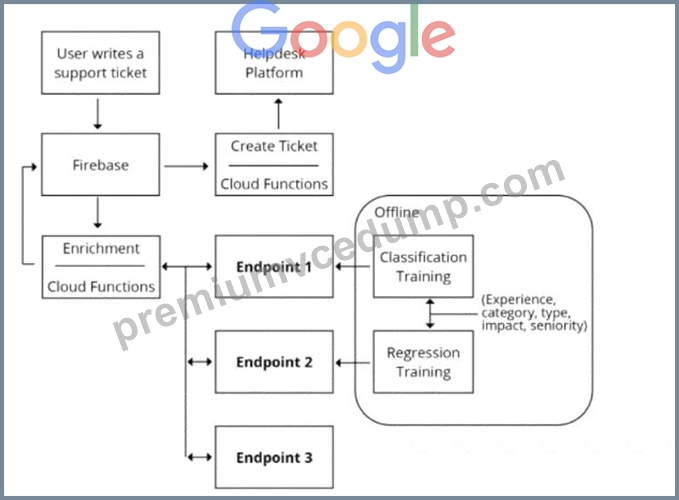
Which endpoints should the Enrichment Cloud Functions call?
- A. 1 = Vertex Al. 2 = Vertex Al. 3 = AutoML Natural Language
- B. 1 = Vertex Al. 2 = Vertex Al. 3 = Cloud Natural Language API
- C. 1 = Vertex Al. 2 = Vertex Al. 3 = AutoML Vision
- D. 1 = Cloud Natural Language API. 2 = Vertex Al, 3 = Cloud Vision API
Answer: B
Explanation:
Vertex AI is a unified platform for building and deploying ML models on Google Cloud. It supports both custom and AutoML models, and provides various tools and services for ML development, such as Vertex Pipelines, Vertex Vizier, Vertex Explainable AI, and Vertex Feature Store. Vertex AI can be used to create models for predicting ticket priority and resolution time, as these are domain-specific tasks that require custom training data and evaluation metrics. Cloud Natural Language API is a pre-trained service that provides natural language understanding capabilities, such as sentiment analysis, entity analysis, syntax analysis, and content classification. Cloud Natural Language API can be used toperform sentiment analysis on the support tickets, as this is a general task that does not require domain-specific knowledge or jargon. The other options are not suitable for the given architecture. AutoML Natural Language and AutoML Vision are services that allow users to create custom natural language and vision models using their own data and labels. They are not needed for sentiment analysis, as Cloud Natural Language API already provides this functionality. Cloud Vision API is a pre-trained service that provides image analysis capabilities, such as object detection, face detection, text detection, and image labeling. It is not relevant for the support tickets, as they are not expected to have any images. References:
* Vertex AI documentation
* Cloud Natural Language API documentation
NEW QUESTION # 44
......
Resources From:
- 2025 Latest PremiumVCEDump Professional-Machine-Learning-Engineer Exam Dumps (PDF & Exam Engine) Free Share: https://www.premiumvcedump.com/Google/valid-Professional-Machine-Learning-Engineer-premium-vce-exam-dumps.html
- 2025 Latest PremiumVCEDump Professional-Machine-Learning-Engineer PDF and Professional-Machine-Learning-Engineer Exam Dumps Free Share: https://drive.google.com/open?id=1hCvnj7HSRvf1H5-doj76JmqxcedARZPH
Free Resources from PremiumVCEDump, We Devoted to Helping You 100% Pass All Exams!