

[Jan 02, 2024] Download Free Google Professional-Machine-Learning-Engineer Real Exam Questions
Pass Your Exam With 100% Verified Professional-Machine-Learning-Engineer Exam Questions
NEW QUESTION # 14
You work for a company that is developing a new video streaming platform. You have been asked to create a recommendation system that will suggest the next video for a user to watch. After a review by an AI Ethics team, you are approved to start development. Each video asset in your company's catalog has useful metadata (e.g., content type, release date, country), but you do not have any historical user event dat a. How should you build the recommendation system for the first version of the product?
- A. Launch the product without machine learning. Use simple heuristics based on content metadata to recommend similar videos to users, and start collecting user event data so you can develop a recommender model in the future.
- B. Launch the product with machine learning. Generate embeddings for each video by training an autoencoder on the content metadata using TensorFlow. Cluster content based on the similarity of these embeddings, and then recommend videos from the same cluster.
- C. Launch the product with machine learning. Use a publicly available dataset such as MovieLens to train a model using the Recommendations AI, and then apply this trained model to your data.
- D. Launch the product without machine learning. Present videos to users alphabetically, and start collecting user event data so you can develop a recommender model in the future.
Answer: C
NEW QUESTION # 15
You work for a large hotel chain and have been asked to assist the marketing team in gathering predictions for a targeted marketing strategy. You need to make predictions about user lifetime value (LTV) over the next 30 days so that marketing can be adjusted accordingly. The customer dataset is in BigQuery, and you are preparing the tabular data for training with AutoML Tables. This data has a time signal that is spread across multiple columns. How should you ensure that AutoML fits the best model to your data?
- A. Submit the data for training without performing any manual transformations Allow AutoML to handle the appropriate transformations Choose an automatic data split across the training, validation, and testing sets
- B. Manually combine all columns that contain a time signal into an array Allow AutoML to interpret this array appropriately Choose an automatic data split across the training, validation, and testing sets
- C. Submit the data for training without performing any manual transformations, and indicate an appropriate column as the Time column Allow AutoML to split your data based on the time signal provided, and reserve the more recent data for the validation and testing sets
- D. Submit the data for training without performing any manual transformations Use the columns that have a time signal to manually split your data Ensure that the data in your validation set is from 30 days after the data in your training set and that the data in your testing set is from 30 days after your validation set
Answer: D
NEW QUESTION # 16
You built and manage a production system that is responsible for predicting sales numbers. Model accuracy is crucial, because the production model is required to keep up with market changes. Since being deployed to production, the model hasn't changed; however the accuracy of the model has steadily deteriorated. What issue is most likely causing the steady decline in model accuracy?
- A. Poor data quality
- B. Incorrect data split ratio during model training, evaluation, validation, and test
- C. Lack of model retraining
- D. Too few layers in the model for capturing information
Answer: B
NEW QUESTION # 17
You are training models in Vertex Al by using data that spans across multiple Google Cloud Projects You need to find track, and compare the performance of the different versions of your models Which Google Cloud services should you include in your ML workflow?
- A. Dataplex. Vertex Al Experiments, and Vertex Al ML Metadata
- B. Vertex Al Pipelines: Vertex Al Experiments and Vertex Al Metadata
- C. Dataplex. Vertex Al Feature Store and Vertex Al TensorBoard
- D. Vertex Al Pipelines, Vertex Al Feature Store, and Vertex Al Experiments
Answer: B
NEW QUESTION # 18
Your team is working on an NLP research project to predict political affiliation of authors based on articles they have written. You have a large training dataset that is structured like this: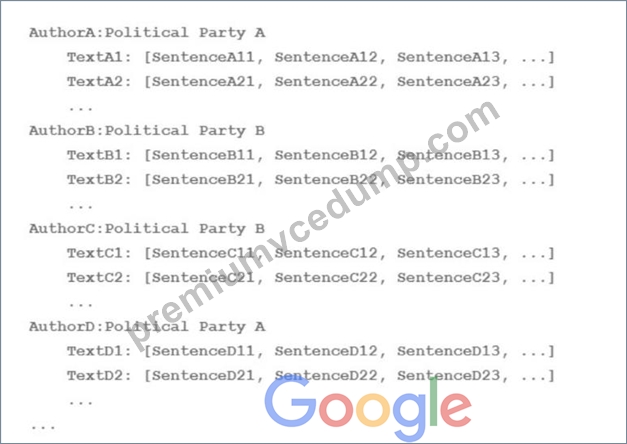
A)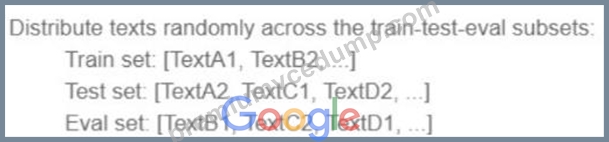
B)
C)
D)
- A. Option D
- B. Option B
- C. Option A
- D. Option C
Answer: B
Explanation:
If we just put inside the Training set , Validation set and Test set , randomly Text, Paragraph or sentences the model will have the ability to learn specific qualities about The Author's use of language beyond just his own articles. Therefore the model will mixed up different opinions. Rather if we divided things up a the author level, so that given authors were only on the training data, or only in the test data or only in the validation data. The model will find more difficult to get a high accuracy on the test validation (What is correct and have more sense!). Because it will need to really focus in author by author articles rather than get a single political affiliation based on a bunch of mixed articles from different authors. https://developers.google.com/machine-learning/crash-course/18th-century-literature For example, suppose you are training a model with purchase data from a number of stores. You know, however, that the model will be used primarily to make predictions for stores that are not in the training data. To ensure that the model can generalize to unseen stores, you should segregate your data sets by stores. In other words, your test set should include only stores different from the evaluation set, and the evaluation set should include only stores different from the training set. https://cloud.google.com/automl-tables/docs/prepare#ml-use
NEW QUESTION # 19
You need to build an ML model for a social media application to predict whether a user's submitted profile photo meets the requirements. The application will inform the user if the picture meets the requirements. How should you build a model to ensure that the application does not falsely accept a non-compliant picture?
- A. Use Vertex AI Workbench user-managed notebooks to build a custom model that has three times as many examples of pictures that meet the profile photo requirements.
- B. Use AutoML to optimize the model's F1 score in order to balance the accuracy of false positives and false negatives.
- C. Use Vertex AI Workbench user-managed notebooks to build a custom model that has three times as many examples of pictures that do not meet the profile photo requirements.
- D. Use AutoML to optimize the model's recall in order to minimize false negatives.
Answer: A
NEW QUESTION # 20
You are a data scientist at an industrial equipment manufacturing company. You are developing a regression model to estimate the power consumption in the company's manufacturing plants based on sensor data collected from all of the plants. The sensors collect tens of millions of records every day. You need to schedule daily training runs for your model that use all the data collected up to the current date. You want your model to scale smoothly and require minimal development work. What should you do?
- A. Develop a custom scikit-learn regression model, and optimize it using Vertex Al Training
- B. Develop a custom TensorFlow regression model, and optimize it using Vertex Al Training.
- C. Develop a regression model using BigQuery ML.
- D. Develop a custom PyTorch regression model, and optimize it using Vertex Al Training
Answer: C
Explanation:
BigQuery ML is a powerful tool that allows you to build and deploy machine learning models directly within BigQuery, Google's fully-managed, serverless data warehouse. It allows you to create regression models using SQL, which is a familiar and easy-to-use language for many data scientists. It also allows you to scale smoothly and require minimal development work since you don't have to worry about cluster management and it's fully-managed by Google.
BigQuery ML also allows you to run your training on the same data where it's stored, this will minimize data movement, and thus minimize cost and time.
Reference:
BigQuery ML
BigQuery ML for regression
BigQuery ML for scalability
NEW QUESTION # 21
You are designing an architecture with a serveress ML system to enrich customer support tickets with informative metadata before they are routed to a support agent. You need a set of models to predict ticket priority, predict ticket resolution time, and perform sentiment analysis to help agents make strategic decisions when they process support requests. Tickets are not expected to have any domain-specific terms or jargon.
The proposed architecture has the following flow: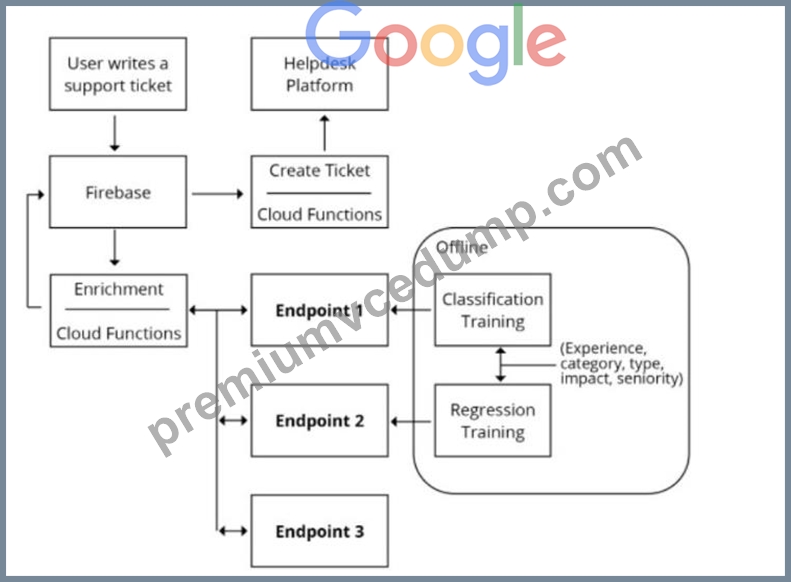
Which endpoints should the Enrichment Cloud Functions call?
- A. 1 = Al Platform, 2 = Al Platform, 3 = Cloud Natural Language API
- B. 1 = Al Platform, 2 = Al Platform, 3 = AutoML Natural Language
- C. 1 = cloud Natural Language API, 2 = Al Platform, 3 = Cloud Vision API
- D. 1 = Al Platform, 2 = Al Platform, 3 = AutoML Vision
Answer: B
NEW QUESTION # 22
Your data science team has requested a system that supports scheduled model retraining, Docker containers, and a service that supports autoscaling and monitoring for online prediction requests. Which platform components should you choose for this system?
- A. Kubeflow Pipelines and Al Platform Prediction
- B. Cloud Composer, BigQuery ML , and Al Platform Prediction
- C. Cloud Composer, Al Platform Training with custom containers , and App Engine
- D. Kubeflow Pipelines and App Engine
Answer: A
NEW QUESTION # 23
You are building a TensorFlow text-to-image generative model by using a dataset that contains billions of images with their respective captions. You want to create a low maintenance, automated workflow that reads the data from a Cloud Storage bucket collects statistics, splits the dataset into training/validation/test datasets performs data transformations, trains the model using the training/validation datasets. and validates the model by using the test dataset. What should you do?
- A. Use the MLFlow SDK and deploy it on a Google Kubernetes Engine Cluster Create multiple components that use Dataflow and Vertex Al services.
- B. Use the Kubeflow Pipelines (KFP) SDK to create multiple components that use Dataflow and Vertex Al services Deploy the workflow on Vertex Al Pipelines.
- C. Use the Apache Airflow SDK to create multiple operators that use Dataflow and Vertex Al services Deploy the workflow on Cloud Composer.
- D. Use the TensorFlow Extended (TFX) SDK to create multiple components that use Dataflow and Vertex Al services Deploy the workflow on Vertex Al Pipelines.
Answer: D
NEW QUESTION # 24
You work for a large retailer and you need to build a model to predict customer churn. The company has a dataset of historical customer data, including customer demographics, purchase history, and website activity. You need to create the model in BigQuery ML and thoroughly evaluate its performance. What should you do?
- A. Create a logistic regression model in BigQuery ML Use the ml.confusion_matrix function to evaluate the model performance.
- B. Create a linear regression model in BigQuery ML and register the model in Vertex Al Model Registry Evaluate the model performance in Vertex Al.
- C. Create a linear regression model in BigQuery ML Use the ml. evaluate function to evaluate the model performance.
- D. Create a logistic regression model in BigQuery ML and register the model in Vertex Al Model Registry. Evaluate the model performance in Vertex Al.
Answer: D
NEW QUESTION # 25
A Machine Learning team uses Amazon SageMaker to train an Apache MXNet handwritten digit classifier model using a research dataset. The team wants to receive a notification when the model is overfitting.
Auditors want to view the Amazon SageMaker log activity report to ensure there are no unauthorized API calls.
What should the Machine Learning team do to address the requirements with the least amount of code and fewest steps?
- A. Use AWS CloudTrail to log Amazon SageMaker API calls to Amazon S3. Set up Amazon SNS to receive a notification when the model is overfitting
- B. Implement an AWS Lambda function to log Amazon SageMaker API calls to AWS CloudTrail. Add code to push a custom metric to Amazon CloudWatch. Create an alarm in CloudWatch with Amazon SNS to receive a notification when the model is overfitting.
- C. Implement an AWS Lambda function to log Amazon SageMaker API calls to Amazon S3. Add code to push a custom metric to Amazon CloudWatch. Create an alarm in CloudWatch with Amazon SNS to receive a notification when the model is overfitting.
- D. Use AWS CloudTrail to log Amazon SageMaker API calls to Amazon S3. Add code to push a custom metric to Amazon CloudWatch. Create an alarm in CloudWatch with Amazon SNS to receive a notification when the model is overfitting.
Answer: B
NEW QUESTION # 26
You have deployed multiple versions of an image classification model on Al Platform. You want to monitor the performance of the model versions overtime. How should you perform this comparison?
- A. Compare the receiver operating characteristic (ROC) curve for each model using the What-lf Tool
- B. Compare the loss performance for each model on the validation data
- C. Compare the mean average precision across the models using the Continuous Evaluation feature
- D. Compare the loss performance for each model on a held-out dataset.
Answer: C
Explanation:
https://cloud.google.com/ai-platform/prediction/docs/continuous-evaluation/view-metrics
NEW QUESTION # 27
The displayed graph is from a forecasting model for testing a time series.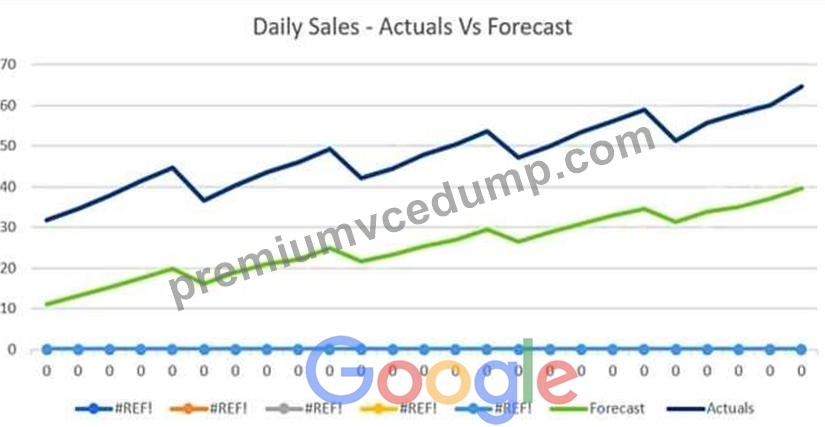
Considering the graph only, which conclusion should a Machine Learning Specialist make about the behavior of the model?
- A. The model predicts both the trend and the seasonality well
- B. The model does not predict the trend or the seasonality well.
- C. The model predicts the trend well, but not the seasonality.
- D. The model predicts the seasonality well, but not the trend.
Answer: B
NEW QUESTION # 28
You work on a team that builds state-of-the-art deep learning models by using the TensorFlow framework. Your team runs multiple ML experiments each week which makes it difficult to track the experiment runs. You want a simple approach to effectively track, visualize and debug ML experiment runs on Google Cloud while minimizing any overhead code. How should you proceed?
- A. Set up Vertex Al Experiments to track metrics and parameters Configure Vertex Al TensorBoard for visualization.
- B. Set up a Cloud Function to write and save metrics files to a Cloud Storage Bucket Configure a Google Cloud VM to host TensorBoard locally for visualization.
- C. Set up a Cloud Function to write and save metrics files to a BigQuery table. Configure a Google Cloud VM to host TensorBoard locally for visualization.
- D. Set up a Vertex Al Workbench notebook instance Use the instance to save metrics data in a Cloud Storage bucket and to host TensorBoard locally for visualization.
Answer: A
NEW QUESTION # 29
You want to train an AutoML model to predict house prices by using a small public dataset stored in BigQuery. You need to prepare the data and want to use the simplest most efficient approach. What should you do?
- A. Use Dataflow to preprocess the data Write the output in TFRecord format to a Cloud Storage bucket.
- B. Write a query that preprocesses the data by using BigQuery and creates a new table Create a Vertex Al managed dataset with the new table as the data source.
- C. Use a Vertex Al Workbench notebook instance to preprocess the data by using the pandas library Export the data as CSV files, and use those files to create a Vertex Al managed dataset.
- D. Write a query that preprocesses the data by using BigQuery Export the query results as CSV files and use those files to create a Vertex Al managed dataset.
Answer: B
NEW QUESTION # 30
You are an ML engineer at a manufacturing company You are creating a classification model for a predictive maintenance use case You need to predict whether a crucial machine will fail in the next three days so that the repair crew has enough time to fix the machine before it breaks. Regular maintenance of the machine is relatively inexpensive, but a failure would be very costly You have trained several binary classifiers to predict whether the machine will fail. where a prediction of 1 means that the ML model predicts a failure.
You are now evaluating each model on an evaluation dataset. You want to choose a model that prioritizes detection while ensuring that more than 50% of the maintenance jobs triggered by your model address an imminent machine failure. Which model should you choose?
- A. The model with the highest recall where precision is greater than 0.5.
- B. The model with the highest precision where recall is greater than 0.5.
- C. The model with the highest area under the receiver operating characteristic curve (AUC ROC) and precision greater than 0 5
- D. The model with the lowest root mean squared error (RMSE) and recall greater than 0.5.
Answer: A
Explanation:
In predictive maintenance, the goal is to identify which machines are likely to fail soon, so that the repair crew can fix them before they break. In this context, it is important to prioritize detection, while also ensuring that more than 50% of the maintenance jobs triggered by your model address an imminent machine failure.
Recall is a metric that measures the proportion of actual positive observations that are correctly predicted as such by the model. In this case, recall is a good metric to use because it measures how well the model is able to identify the machines that are likely to fail soon.
Precision is a metric that measures the proportion of positive predictions that are actually true. In this case, precision is also important because it measures how many of the machines that the model predicts will fail soon, actually do fail soon.
By combining these two metrics, you can ensure that your model is able to identify the machines that are likely to fail soon with a high degree of accuracy. In this case, the model with the highest recall where precision is greater than 0.5 will be the best model, as it will have a high ability to identify the machines that are likely to fail soon and also it will have a high degree of accuracy.
Reference:
Recall and Precision
Predictive Maintenance
Metrics for classification
NEW QUESTION # 31
You are developing a Kubeflow pipeline on Google Kubernetes Engine. The first step in the pipeline is to issue a query against BigQuery. You plan to use the results of that query as the input to the next step in your pipeline. You want to achieve this in the easiest way possible. What should you do?
- A. Use the BigQuery console to execute your query and then save the query results Into a new BigQuery table.
- B. Write a Python script that uses the BigQuery API to execute queries against BigQuery Execute this script as the first step in your Kubeflow pipeline
- C. Use the Kubeflow Pipelines domain-specific language to create a custom component that uses the Python BigQuery client library to execute queries
- D. Locate the Kubeflow Pipelines repository on GitHub Find the BigQuery Query Component, copy that component's URL, and use it to load the component into your pipeline. Use the component to execute queries against BigQuery
Answer: A
NEW QUESTION # 32
You are an ML engineer on an agricultural research team working on a crop disease detection tool to detect leaf rust spots in images of crops to determine the presence of a disease. These spots, which can vary in shape and size, are correlated to the severity of the disease. You want to develop a solution that predicts the presence and severity of the disease with high accuracy. What should you do?
- A. Develop an image segmentation ML model to locate the boundaries of the rust spots.
- B. Create an object detection model that can localize the rust spots.
- C. Develop a template matching algorithm using traditional computer vision libraries.
- D. Develop an image classification ML model to predict the presence of the disease.
Answer: A
NEW QUESTION # 33
You have trained a deep neural network model on Google Cloud. The model has low loss on the training data, but is performing worse on the validation dat a. You want the model to be resilient to overfitting. Which strategy should you use when retraining the model?
- A. Apply a dropout parameter of 0 2, and decrease the learning rate by a factor of 10
- B. Run a hyperparameter tuning job on Al Platform to optimize for the learning rate, and increase the number of neurons by a factor of 2.
- C. Apply a 12 regularization parameter of 0.4, and decrease the learning rate by a factor of 10.
- D. Run a hyperparameter tuning job on Al Platform to optimize for the L2 regularization and dropout parameters
Answer: A
NEW QUESTION # 34
You deployed an ML model into production a year ago. Every month, you collect all raw requests that were sent to your model prediction service during the previous month. You send a subset of these requests to a human labeling service to evaluate your model's performance. After a year, you notice that your model's performance sometimes degrades significantly after a month, while other times it takes several months to notice any decrease in performance. The labeling service is costly, but you also need to avoid large performance degradations. You want to determine how often you should retrain your model to maintain a high level of performance while minimizing cost. What should you do?
- A. Run training-serving skew detection batch jobs every few days to compare the aggregate statistics of the features in the training dataset with recent serving data. If skew is detected, send the most recent serving data to the labeling service.
- B. Train an anomaly detection model on the training dataset, and run all incoming requests through this model. If an anomaly is detected, send the most recent serving data to the labeling service.
- C. Compare the cost of the labeling service with the lost revenue due to model performance degradation over the past year. If the lost revenue is greater than the cost of the labeling service, increase the frequency of model retraining; otherwise, decrease the model retraining frequency.
- D. Identify temporal patterns in your model's performance over the previous year. Based on these patterns, create a schedule for sending serving data to the labeling service for the next year.
Answer: B
NEW QUESTION # 35
You have been asked to productionize a proof-of-concept ML model built using Keras. The model was trained in a Jupyter notebook on a data scientist's local machine. The notebook contains a cell that performs data validation and a cell that performs model analysis. You need to orchestrate the steps contained in the notebook and automate the execution of these steps for weekly retraining. You expect much more training data in the future. You want your solution to take advantage of managed services while minimizing cost. What should you do?
- A. Move the Jupyter notebook to a Notebooks instance on the largest N2 machine type, and schedule the execution of the steps in the Notebooks instance using Cloud Scheduler.
- B. Rewrite the steps in the Jupyter notebook as an Apache Spark job, and schedule the execution of the job on ephemeral Dataproc clusters using Cloud Scheduler.
- C. Write the code as a TensorFlow Extended (TFX) pipeline orchestrated with Vertex AI Pipelines. Use standard TFX components for data validation and model analysis, and use Vertex AI Pipelines for model retraining.
- D. Extract the steps contained in the Jupyter notebook as Python scripts, wrap each script in an Apache Airflow BashOperator, and run the resulting directed acyclic graph (DAG) in Cloud Composer.
Answer: C
NEW QUESTION # 36
......
Professional-Machine-Learning-Engineer Dumps 100 Pass Guarantee With Latest Demo: https://www.premiumvcedump.com/Google/valid-Professional-Machine-Learning-Engineer-premium-vce-exam-dumps.html
Professional-Machine-Learning-Engineer Dumps PDF - Professional-Machine-Learning-Engineer Real Exam Questions Answers: https://drive.google.com/open?id=1bRV-DdNFI-rjRCoT9WVyaEASztH1NVIJ