

Study HIGH Quality UiPath-ADAv1 Free Study Guides and Exams Tutorials
Download UiPath UiPath-ADAv1 Exam Dumps to Pass Exam Easily
UiPath UiPath-ADAv1 Exam Syllabus Topics:
| Topic | Details |
|---|---|
| Topic 1 |
|
| Topic 2 |
|
| Topic 3 |
|
| Topic 4 |
|
| Topic 5 |
|
| Topic 6 |
|
| Topic 7 |
|
| Topic 8 |
|
| Topic 9 |
|
| Topic 10 |
|
| Topic 11 |
|
| Topic 12 |
|
| Topic 13 |
|
NEW QUESTION # 198
A developer is using the REFramework template to automate a process. In "SetTransactionStatus" file, there is the following sequence of activities, where the last Log Message activity was added by the developer:
The configuration for Add Log Fields and Remove Log Fields activities are shown below:
Add transaction log fields (Success)

The developer runs the process and notices the argument values for the first transaction are:
in_TransactionlD = "07/18/2023 10:27:29"
io_TransactionNumber = 1
in_TransactionField1 = "UI235-80"
in_TransactionField2 = "Update Request"
Which of the following Log Message Details will be displayed when executing the activity Log Message Completed for the first transaction, considering it is successful?
- A. "message": "Transaction Completed",
"level": "Information",
"logType": "User",
"timeStamp": "10:30:19",
"fileName": "SetTransactionStatus",
"processVersion": "1.0.0",
"jobId": "59325301-680a-4d55-a81b-56ca1f369c12",
"robotName": "test.robot",
"machineId": 0,
"logF_TransactionField2": empty,
"logF_TransactionStatus": empty,
"logF_TransactionID": empty,
"logF_BusinessProcessName": "Framework",
"logF_TransactionNumber": empty,
"logF_TransactionField1": empty
} - B. "message": "Transaction Completed",
"level": "Information",
"logType": "User",
"timeStamp": "10:30:19",
"fileName": "SetTransactionStatus",
"processVersion": "1.0.0",
"jobId": "f8a36a46-8ebc-40df-8f71-26b39087ebee",
"robotName": "test.robot",
"machineId": 0,
"logF_BusinessProcessName": "Framework"
} - C. "message": "Transaction Completed",
"level": "Information",
"logType": "User",
"timeStamp": "10:30:19",
"fileName": "SetTransactionStatus",
"processVersion": "1.0.0",
"jobId": "cb865477-35f8-4c0a-93e9-e4f4246223f2",
"robotName": "test.robot",
"machineId": 0,
"logF_TransactionField2": "Update Request",
"logF_TransactionID": "07/18/2023 10:27:29",
"logF_BusinessProcessName": "Framework",
"logF_TransactionNumber": "1",
"logF_TransactionField1": "UI235-80",
"logF_TransactionStatus": "Success" - D. "message": "Transaction Completed",
"level": "Information",
"logType": "User",
"timeStamp": "10:30:19",
"fileName": "SetTransactionStatus",
"processVersion": "1.0.0",
"jobId": "59325301-680a-4d55-a81b-56ca1f369c12",
"robotName": "test.robot",
"machineId": 0,
"logF_TransactionField2": ""
"logF_TransactionStatus":
"logF_TransactionID"; "",
"logF_BusinessProcessName": "Framework",
"logF_TransactionNumber": ""
"logF_TransactionField1":
}
Answer: C
Explanation:
Explanation
The Log Message activity is used to write a diagnostic message at a specified level to the output panel, the log file, and Orchestrator1. The message can include custom log fields that are added by the Add Log Fields activity and removed by the Remove Log Fields activity2. In this case, the developer has added six log fields in the Add transaction log fields (Success) sequence and removed three of them in the Remove transaction log fields sequence. Therefore, the remaining three log fields (logF_TransactionField2, logF_TransactionID, and logF_TransactionStatus) will be displayed along with the default log fields (message, level, logType, timeStamp, fileName, processVersion, jobId, robotName, and machineId) when executing the Log Message Completed activity. The values of the log fields will be taken from the corresponding arguments of the Set Transaction Status activity.
References:
Add Log Fields activity documentation from UiPath
Remove Log Fields activity documentation from UiPath
Log Message activity documentation from UiPath
NEW QUESTION # 199
A developer is using the REFramework template to automate a process. In "SetTransactionStatus" file, there is the following sequence of activities, where the last Log Message activity was added by the developer:
The configuration for Add Log Fields and Remove Log Fields activities are shown below:
Add transaction log fields (Success)

The developer runs the process and notices the argument values for the first transaction are:
in_TransactionlD = "07/18/2023 10:27:29"
io_TransactionNumber = 1
in_TransactionField1 = "UI235-80"
in_TransactionField2 = "Update Request"
Which of the following Log Message Details will be displayed when executing the activity Log Message Completed for the first transaction, considering it is successful?
- A. "message": "Transaction Completed",
"level": "Information",
"logType": "User",
"timeStamp": "10:30:19",
"fileName": "SetTransactionStatus",
"processVersion": "1.0.0",
"jobId": "59325301-680a-4d55-a81b-56ca1f369c12",
"robotName": "test.robot",
"machineId": 0,
"logF_TransactionField2": empty,
"logF_TransactionStatus": empty,
"logF_TransactionID": empty,
"logF_BusinessProcessName": "Framework",
"logF_TransactionNumber": empty,
"logF_TransactionField1": empty
} - B. "message": "Transaction Completed",
"level": "Information",
"logType": "User",
"timeStamp": "10:30:19",
"fileName": "SetTransactionStatus",
"processVersion": "1.0.0",
"jobId": "f8a36a46-8ebc-40df-8f71-26b39087ebee",
"robotName": "test.robot",
"machineId": 0,
"logF_BusinessProcessName": "Framework"
} - C. "message": "Transaction Completed",
"level": "Information",
"logType": "User",
"timeStamp": "10:30:19",
"fileName": "SetTransactionStatus",
"processVersion": "1.0.0",
"jobId": "cb865477-35f8-4c0a-93e9-e4f4246223f2",
"robotName": "test.robot",
"machineId": 0,
"logF_TransactionField2": "Update Request",
"logF_TransactionID": "07/18/2023 10:27:29",
"logF_BusinessProcessName": "Framework",
"logF_TransactionNumber": "1",
"logF_TransactionField1": "UI235-80",
"logF_TransactionStatus": "Success" - D. "message": "Transaction Completed",
"level": "Information",
"logType": "User",
"timeStamp": "10:30:19",
"fileName": "SetTransactionStatus",
"processVersion": "1.0.0",
"jobId": "59325301-680a-4d55-a81b-56ca1f369c12",
"robotName": "test.robot",
"machineId": 0,
"logF_TransactionField2": ""
"logF_TransactionStatus":
"logF_TransactionID"; "",
"logF_BusinessProcessName": "Framework",
"logF_TransactionNumber": ""
"logF_TransactionField1":
}
Answer: C
Explanation:
The Log Message activity is used to write a diagnostic message at a specified level to the output panel, the log file, and Orchestrator1. The message can include custom log fields that are added by the Add Log Fields activity and removed by the Remove Log Fields activity2. In this case, the developer has added six log fields in the Add transaction log fields (Success) sequence and removed three of them in the Remove transaction log fields sequence. Therefore, the remaining three log fields (logF_TransactionField2, logF_TransactionID, and logF_TransactionStatus) will be displayed along with the default log fields (message, level, logType, timeStamp, fileName, processVersion, jobId, robotName, and machineId) when executing the Log Message Completed activity. The values of the log fields will be taken from the corresponding arguments of the Set Transaction Status activity.
References:
Add Log Fields activity documentation from UiPath
Remove Log Fields activity documentation from UiPath
Log Message activity documentation from UiPath
NEW QUESTION # 200
What represents a sequence that contains an activity with a partial selector?
- A.

- B.

- C.

- D.

Answer: D
Explanation:
Explanation
A partial selector is a selector that does not contain the information about the top-level window. A partial selector is usually generated when a UI Automation activity is included in a container activity, such as Attach Browser or Attach Window, that has a full selector of the outer window. This way, the UI Automation activity can use the partial selector relative to the container, instead of the full selector from the root. A partial selector is indicated by the icon in the Properties panel of the UI Automation activity. In this question, the sequence that contains an activity with a partial selector is Option B, where the Click activity has the partial selector icon and is enclosed in an Attach Window activity. The other options have activities with full selectors, indicated by the icon . Therefore, the answer is B. Option B. References: Full Versus Partial Selectors, Selectors
NEW QUESTION # 201
A developer wants to add items to a list of strings using the Invoke Method activity. The list is declared as follows: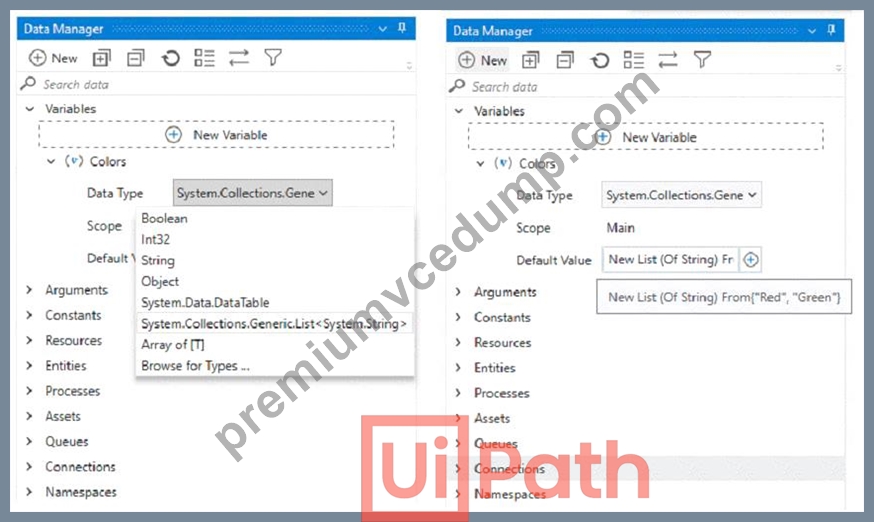
The Invoke Method includes the following properties: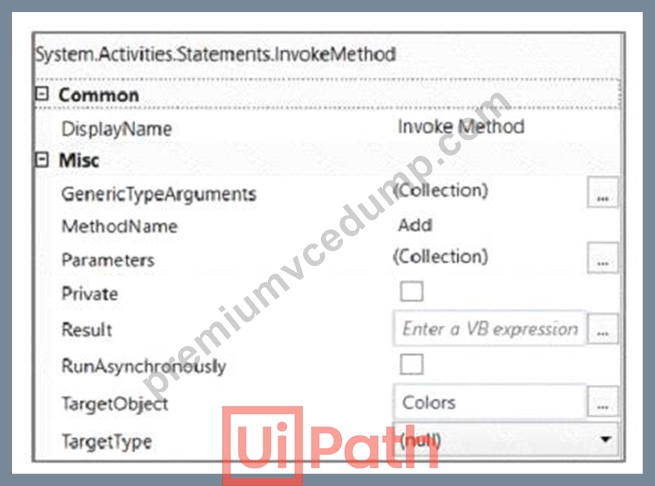
The Parameters property is as follows:
Based on the exhibits, what is the outcome of this Invoke Method activity?
- A. Colors will contain items in the following order: "Red", "Green".
- B. Colors will contain items in the following order: "Red", "Green", "Yellow".
- C. Colors will contain items in the following order: "Yellow", "Red", "Green".
- D. Invoke Method activity will throw an error.
Answer: B
Explanation:
The Invoke Method activity is used to execute a method of a class or an object1. In this case, the developer wants to add items to a list of strings using the Add method of the List class2. The list is declared as Colors and initialized with two items: "Red" and "Green". The Invoke Method activity has the following properties:
TargetObject: Colors (the list variable)
MethodName: Add (the method of the List class)
Parameters: Direction - In, Type - String, Value - "Yellow" (the item to be added to the list) Based on these properties, the Invoke Method activity will add the string "Yellow" to the end of the Colors list. Therefore, the outcome of this Invoke Method activity is that Colors will contain items in the following order: "Red", "Green", "Yellow".
Option A is incorrect because the Invoke Method activity will not throw an error, as the properties are configured correctly. Option B is incorrect because the order of the items in the list will not change, as the Add method appends the item to the end of the list. Option D is incorrect because the list will have three items, not two, as the Add method does not overwrite any existing item.
References:
Invoke Method activity documentation from UiPath
List<T>.Add(T) Method documentation from Microsoft
NEW QUESTION # 202
A developer downloads a published package from UiPath Orchestrator 2021.10 to use locally. What is the extension of the downloaded package?
- A. .zip
- B. .nupkg
- C. .dll
- D. .csproj
Answer: B
Explanation:
The extension of the downloaded package from UiPath Orchestrator 2021.10 to use locally is .nupkg. A package is a file that contains the workflows and the dependencies of a project that is ready to be executed by a robot. A package can be created and published from UiPath Studio, or uploaded manually to UiPath Orchestrator. A package can also be downloaded from UiPath Orchestrator to use locally, such as for debugging or testing purposes. The extension of the package file is .nupkg, which is the standard extension for NuGet packages. NuGet is a package manager that is used to manage the dependencies of a project, such as libraries, frameworks, or components3. A .nupkg file is essentially a ZIP archive that contains the files and metadata of the package4. For example, if a package named Process1 is downloaded from UiPath Orchestrator, the file name and extension will be Process1.nupkg. The .nupkg file can be opened or extracted using a ZIP utility, such as 7-Zip or WinZip, or renamed to .zip and extracted using Windows Explorer5.
NEW QUESTION # 203
Which activity can be used to transition a Background Process to Foreground?
- A. Activate
- B. Maximize Window
- C. Use Foreground
- D. Set Focus
Answer: C
Explanation:
Explanation
The Use Foreground activity can be used to transition a Background Process to Foreground. It allows you to perform UI automation tasks that require user interaction or visibility1. The other activities are not suitable for this purpose.
References:
Background Process Automation documentation, Transitioning a Background Process to Foreground section
NEW QUESTION # 204
What is the functionality of the Include Subfolders filter in the Monitoring pages when a modern folder is selected?
- A. It allows you to allocate licenses per machine for the displayed data.
- B. It allows you to choose between background and foreground processes for the displayed data.
- C. It enables you to sort the displayed data based on job priorities.
- D. It allows you to select whether the contents of the selected folder's subfolders are displayed.
Answer: D
Explanation:
The Include Subfolders filter is a toggle button that appears in the Monitoring pages when a modern folder is selected from the Folders drop-down list1. The modern folders are folders that can have subfolders and support role-based access control2. The Include Subfolders filter allows you to choose whether to display the data for the selected folder only, or for the selected folder and all its subfolders3. This filter applies to the Jobs, Queues, Triggers, and Robots pages4. The Include Subfolders filter helps you to monitor and manage the processes and resources across different levels of folders.
https://forum.uipath.com/t/read-all-file-from-sub-folder-and-sub-folder-of-sub-folder/460493
NEW QUESTION # 205
When encountering an ApplicationException, what occurs if the developer chooses InvalidOperationException as the exception handler within the Catches section of the Try Catch activity?
- A. No exception is thrown and the Finally block executes.
- B. The Finally block is executed and the Catches section catches the exception.
- C. A runtime error occurs and the Finally block is not executed.
- D. No exceptions are happening and the workflow continues to execute.
Answer: C
Explanation:
Explanation
The Try Catch activity is used to handle errors and exceptions that may occur during the execution of a workflow1. It has three sections: Try, Catches, and Finally1.
The Try section contains the activities that may throw an exception or an error. If an exception or an error occurs, the execution of the Try section is stopped and the control is passed to the Catches section1.
The Catches section contains one or more exception handlers that specify what type of exception or error to catch and what actions to perform when it is caught. The exception handlers are executed in order, from top to bottom, until a matching exception or error is found. If no matching exception or error is found, the execution of the workflow is stopped and a runtime error is thrown1.
The Finally section contains the activities that are always executed at the end of the Try Catch activity, regardless of whether an exception or error occurred or not. The Finally section is used to perform cleanup actions, such as closing applications, releasing resources, or logging messages1.
In your case, you have configured the properties for the Try Catch activity as follows:
The Try section contains a Throw activity with an ApplicationException.
The Catches section contains an InvalidOperationException with a Message Box activity and a Log Message activity.
The Finally section is empty.
This means that the Try Catch activity will throw an ApplicationException in the Try section and look for a matching exception handler in the Catches section. However, since you have chosen InvalidOperationException as the exception handler, which does not match the ApplicationException, the execution of the workflow will be stopped and a runtime error will occur. The Finally section will not be executed.
Therefore, option B is correct.
References: Try Catch - UiPath Documentation Portal.
NEW QUESTION # 206
A developer is building a process that types data into input fields using the Hardware Events input method.
Which property of the Type Into activity should be modified to reduce the pace at which the input string characters are typed into the fields?
- A. Delay after
- B. Delay before
- C. Alter disabled element
- D. Delay between keys
Answer: D
Explanation:
The Delay between keys property of the Type Into activity specifies the time (in milliseconds) between each keystroke when using the Hardware Events input method. Increasing this value can slow down the typing speed and reduce the risk of missing or skipping characters. (UiPath Automation Developer study guide) References:
Type Into
Input Methods
NEW QUESTION # 207
While working in an RPA testing project, you encountered the following activity in one of the workflows included in the project.
What action can you perform in your mocked file to replace the functionality of the MessageBox with a LogMessage during mock testing?
- A. Surround activity with mock.
- B. Remove mock activity.
- C. Synchronize mock.
- D. Create mock workflow.
Answer: A
Explanation:
The Surround activity with mock option is used to create a mock activity that wraps around the original activity in the workflow. The mock activity can have different properties and actions than the original activity, depending on the testing scenario. In this case, the MessageBox activity can be surrounded with a mock activity that has the LogMessage action. This will replace the functionality of the MessageBox with a LogMessage during mock testing, which can be useful for logging the test results without interrupting the workflow execution. (UiPath Studio documentation1) References:
1: Configuring Activity Project Settings - UiPath Studio.
NEW QUESTION # 208
What is the default polling interval set for an event trigger?
- A. 1 minute
- B. 10 minutes
- C. 5 minutes
- D. 15 minutes
Answer: C
Explanation:
Explanation
The default polling interval for an event trigger is 5 minutes, which means that the trigger checks for new object events every 5 minutes. This value can be customized using the Adjustable Polling Interval feature, which allows users to choose the interval on which event triggers check for new object events. The polling interval can be changed from a specific connector's page or from the Connections tab. (UiPath Automation Developer study guide) References:
How to modify the polling interval for Integration Service Triggers?
Integration Service - Triggers
UiPath Integration Service - Vote on Tutorials
NEW QUESTION # 209
What is the recommended approach for handling tabular data when building a REFramework transactional project in UiPath?
- A. Implement custom activities to handle the tabular data.
- B. Convert the tabular data into a string format and store it in a single variable.
- C. Use separate variables to store each column of the tabular data.
- D. Utilize a DataTable variable to store and process the tabular data.
Answer: D
Explanation:
A DataTable variable is a data structure that can store and manipulate tabular data in UiPath. A DataTable variable has rows and columns that correspond to the rows and columns of the tabular data source, such as an Excel or CSV file. A DataTable variable can be used to store the input data for a REFramework transactional project, where each row represents a transaction item. The REFramework template can be modified to use a DataTable variable as the TransactionItem type and to process each row in the GetTransactionData and ProcessTransaction workflows. Using a DataTable variable is the recommended approach for handling tabular data when building a REFramework transactional project in UiPath, because it is efficient, flexible, and easy to use. (UiPath ReFramework documentation1) References:
1: Robotic Enterprise Framework Template - UiPath Studio.
NEW QUESTION # 210
Following UiPath best practices, which project structure is best-suited for complex processes in UiPath Studio?
- A. Sequence
- B. Flowchart
- C. Global Exception Handler
- D. State Machine
Answer: D
Explanation:
Explanation
According to the UiPath documentation and best practices, the State Machine project structure is best-suited for complex processes that involve multiple states and transitions between them12. A State Machine workflow can model the behavior of a system in terms of states, such as "Init", "Get Transaction Data", "Process Transaction", and "End Process", and transitions, such as "Success", "Business Rule Exception", or "System Error". A State Machine workflow can also have entry and exit actions for each state, which are activities that execute when the system enters or exits the state, respectively1.
A State Machine project structure has several advantages over other project structures, such as Sequence, Flowchart, or Global Exception Handler, for complex processes2:
It can handle complex logic and branching conditions more easily and clearly than a Sequence or a Flowchart, which can become cluttered and hard to maintain for large processes2.
It can handle exceptions and errors more efficiently and consistently than a Global Exception Handler, which is a separate workflow that handles all exceptions in a project. A State Machine can have dedicated states and transitions for handling different types of exceptions, such as business rule exceptions or system errors, and can also use retry mechanisms or recovery actions2.
It can improve the readability, modularity, and reusability of the workflows, by breaking down the process into smaller and coherent states that can be invoked from the main workflow. This also facilitates collaboration and testing among developers2.
Therefore, a State Machine project structure is best-suited for complex processes that involve multiple states and transitions between them.
References:
State Machine Workflows - Campus Management Corp..
UiPath Best Practices - Studio - UiPath Community Forum.
NEW QUESTION # 211
A developer wants to create an automation in which the input from the user and pre-defined conditions determine the transition between stages. In UiPath Studio, which is the recommended type of workflow that meets the requirement?
- A. State Machine
- B. Flowchart
- C. Workflow
- D. Global Exception Handler
Answer: B
Explanation:
A flowchart is a type of workflow that allows developers to create complex and dynamic automation processes that can branch based on user input or predefined conditions. Flowcharts use graphical elements such as shapes, connectors, and annotations to represent the flow of logic and data between different stages or activities. Flowcharts are suitable for scenarios where the automation process is not linear or sequential, but rather depends on various factors and decisions. (UiPath Automation Developer study guide) References:
Flowchart
Types of Workflows
NEW QUESTION # 212
A developer is automating an invoice process for the finance department using a Dispatcher and Performer model with access to Orchestrator. New invoices are added to a shared folder each morning. Each invoice needs to be processed separately in the system, as a single unit of work. After each invoice is processed in the system, the system output ID must be emailed to the finance team email address.
How should the developer store the invoice data in Orchestrator?
- A. Upload individual invoice data as Specific Data in Queue Items and Create an asset for the finance team email address.
- B. Upload the finance team email address as Specific Data in Queue Items and Create an asset for each individual invoice data field.
- C. Upload individual invoice data and the finance team email address as Specific Data in Queue Items.
- D. Create an asset for each piece of invoice data as well as for the finance team email address.
Answer: A
Explanation:
Explanation
This is the best option because it follows the best practices for using queues and assets in Orchestrator. Queues are used to store and process multiple items of data that need to be processed separately, such as invoices.
Each invoice can be uploaded as a queue item with the invoice data as Specific Data, which can be accessed and manipulated by the automation process. Assets are used to store and share global information that is constant or rarely changes, such as the finance team email address. An asset can be created for the email address and retrieved by the automation process when needed. The other options are not optimal because they either use assets for data that is not global or constant, or they use queues for data that is not related to the items to be processed. References: About Queues and Transactions, About Assets
NEW QUESTION # 213
The "Main.xaml" file has an "In" argument of type String with a default value of "String.Empty". What is the runtime value of the argument when executing the process from the Start Job window in UiPath Orchestrator?
- A. An Input Dialog box will prompt the user to input a value and that value will be used.
- B. Only the default value of "String.Empty" will be used, overriding any values provided in Orchestrator.
- C. @ If any input arguments are provided in Orchestrator, those values will be used; otherwise, the default value of "String.Empty" will be used.
- D. A runtime error will occur as arguments are not allowed in the "Main.xaml" file.
Answer: C
Explanation:
When a process is executed from the Start Job window in UiPath Orchestrator, the runtime value of an "In" argument in the "Main.xaml" file will be the value provided in Orchestrator if specified. If no value is provided in Orchestrator for this argument, then the default value specified in the "Main.xaml" file will be used, in this case, "String.Empty". Therefore, option C is correct. Arguments can be passed to the "Main.
xaml" file from Orchestrator, and there is a mechanism to handle default values for arguments in case they are not provided at runtime.
NEW QUESTION # 214
A developer configured the properties for a Click activity as shown below: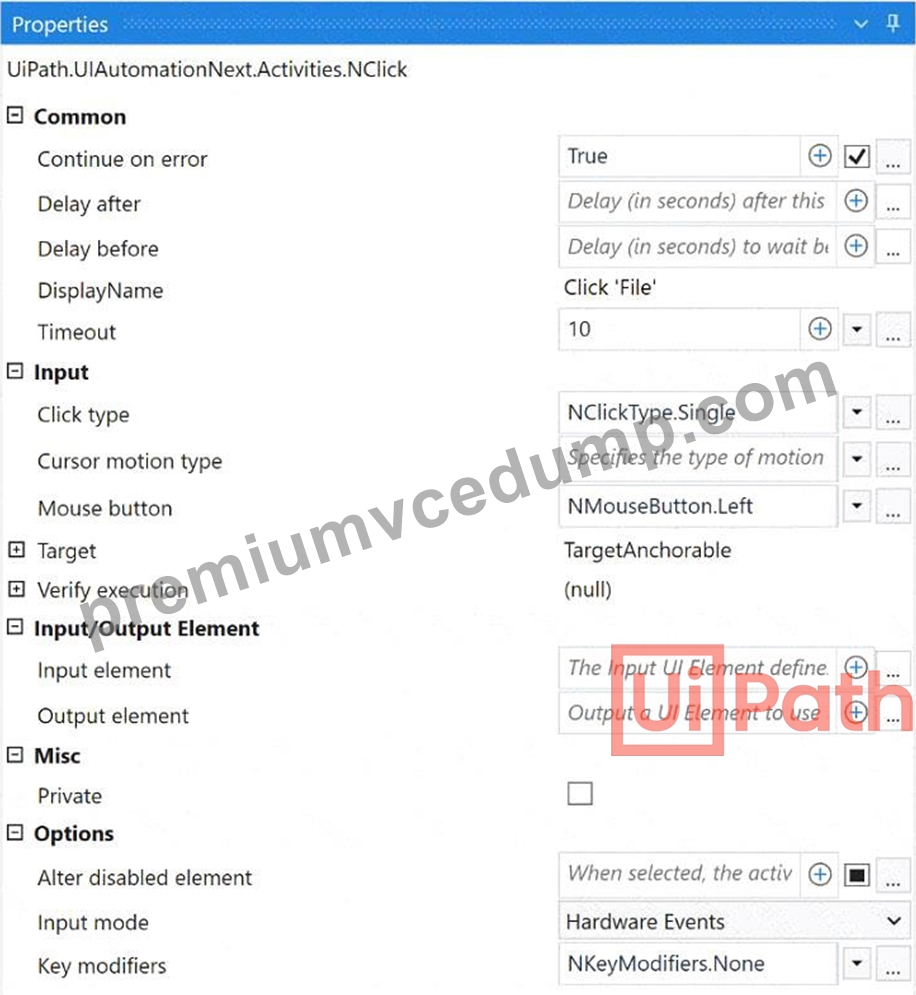
What happens if the activity cannot find its target at runtime?
- A. The next activity is executed after 10 seconds.
- B. An exception is thrown after 10 milliseconds.
- C. The next activity is executed after 10 milliseconds.
- D. An exception is thrown after 10 seconds.
Answer: D
Explanation:
If the activity cannot find its target at runtime, an exception is thrown after 10 seconds. This is because the
"ContinueOnError" property is set to "False" and the "DelayAfter" property is set to "10" seconds. The
"ContinueOnError" property determines whether the automation should continue even when the activity fails, and the "DelayAfter" property specifies the amount of time (in milliseconds) to wait before moving to the next activity. (UiPath Automation Developer study guide) References:
* Click
* Common Properties
NEW QUESTION # 215
Data from an Excel file is read into a data table named "dtEmployee", as displayed in the following graphic:
A developer needs to filter the data table to obtain all rows representing employees from the Finance and IT departments with a Salary under 30,000. Which expression yields the desired outcomes?
- A. dtEmployee.Select("([Department]='IT' AND [Department]='Finance') AND [Salary] < 30000")
- B. dtEmployee.Select("[Department]='IT' OR [Department]='Finance' OR [Salary] < 30000")
- C. dtEmployee.Select("([Department]='IT' OR [Department]='Finance') AND [Salary] < 30000")
- D. dtEmployee.Select("[Department]='IT' OR [Department]='Finance' AND [Salary] < 30000")
Answer: C
Explanation:
Explanation
This expression filters the data table to obtain all rows representing employees from the Finance and IT departments with a Salary under 30,000. The expression uses the Select method of the data table, which returns an array of data rows that match a specified condition. The condition is written as a string that follows the syntax and rules of the DataColumn.Expression property. The condition uses parentheses to group the logical operators OR and AND, which have different precedence levels. The OR operator returns true if either operand is true, while the AND operator returns true only if both operands are true. The condition also uses single quotes to enclose the string values of the Department column, and the less than operator to compare the numeric values of the Salary column. (UiPath Studio documentation1) References:
1: DataTable.Select Method (System.Data) | Microsoft Docs.
NEW QUESTION # 216
A developer configured the properties for a Click activity on an element inside a web page as shown in the following exhibit.
An animation on the web page never completely loads but the element indicated in the Click activity does load within the specified timeout duration. What occurs when this Click activity executes?
- A. Waits 10 seconds before clicking on the element.
- B. Continues to the next activity after 30 seconds without clicking on the element.
- C. Element is clicked once the element is fully loaded.
- D. Timeout error occurs without clicking on the element.
Answer: C
Explanation:
Explanation
The Click activity is used to simulate a mouse click on a specified UI element, such as a button or a link1. It has several properties that can be configured to customize its behavior, such as the input method, the click type, the timeout, and the wait for ready1.
The input method determines how the click is performed. It can be Default, Simulate, or Window Messages. The Default method uses the hardware driver to simulate the click, and it requires the target element to be visible and in focus. The Simulate and Window Messages methods use the technology of the target application to inject the click, and they can work in the background, even if the target element is hidden or minimized2.
The click type determines which mouse button is used for the click. It can be Single, Double, Down, or Up. The Single and Double types perform a single or double click using the left mouse button. The Down and Up types perform a press or release action using any mouse button1.
The timeout determines how long the activity waits for the target element to appear before throwing an error. It is measured in milliseconds, and it has a default value of 30000 (30 seconds). If the timeout is exceeded, the activity fails with a TimeoutException1.
The wait for ready determines when the activity executes. It can be None, Interactive, or Complete. The None option executes the activity immediately. The Interactive option executes the activity after the target element is loaded. The Complete option executes the activity after the target application is loaded1.
In your case, you have configured the properties for the Click activity as follows:
Input method: Simulate
Click type: Single
Timeout: 30000
Wait for ready: Complete
This means that the Click activity will use the Simulate method to perform a single click on the target element in the background, after waiting for 30 seconds or until the target application is fully loaded, whichever comes first.
Since you have mentioned that an animation on the web page never completely loads but the element indicated in the Click activity does load within the specified timeout duration, what occurs when this Click activity executes is:
Element is clicked once the element is fully loaded.
This is because the Simulate method can work in the background, even if the web page is hidden or minimized, and it does not depend on the animation to complete. The Complete option for wait for ready ensures that the Click activity waits until the target element is loaded before clicking on it. The timeout value of 30000 does not affect this scenario, because it is not exceeded.
Therefore, option A is correct.
References:
Click - UiPath Documentation Portal.
What are different Input methods in UiPath - UiPath Community Forum.
NEW QUESTION # 217
What is enabled by connecting UiPath Studio to Orchestrator?
- A. Generating API keys for use in integrations with third party apps.
- B. Creating an Object Repository of elements for use in automations.
- C. Defining queues and arguments for use in automations.
- D. Publishing automation packages to Orchestrator.
Answer: D
Explanation:
Connecting UiPath Studio to Orchestrator enables several features, including publishing automation packages directly to Orchestrator. This connection is crucial for deploying processes and managing automation workflows at scale. It does not directly enable defining queues and arguments for automations (option B), generating API keys for third-party integrations (option C), or creating an Object Repository of elements (option D), although these can be managed within Orchestrator once the package is published.
References:
UiPath Orchestrator Guide: Connecting Robots to Orchestrator
NEW QUESTION # 218
......
Get 100% Real Free UiPath Certified Professional - Developer Track UiPath-ADAv1 Sample Questions: https://www.premiumvcedump.com/UiPath/valid-UiPath-ADAv1-premium-vce-exam-dumps.html
Accurate UiPath-ADAv1 Questions with Free and Fast Updates: https://drive.google.com/open?id=1_gvZUWQU0_OzYYBH-MbPXW1LqnCrrNJ2