

PDF Download Free of JN0-637 Valid Practice Test Questions
JN0-637 Test Engine files, JN0-637 Dumps PDF
NEW QUESTION # 16
Exhibit: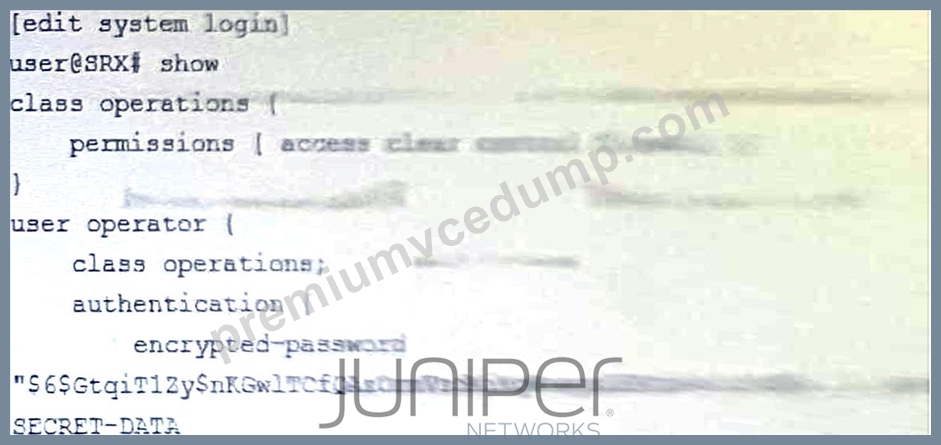
Referring to the exhibit, the operator user is unable to save configuration files to a usb stick the is plugged into SRX.
What should you do to solve this problem?
- A. Add the system permission flag to the operation class
- B. Add the interface-control permission flag to the operation class
- C. Add the system-control permission flag to the operation class
- D. Add the floppy permission flag to the operations class
Answer: C
Explanation:
To solve the problem of the operator user being unable to save configuration files to a USB stick that is plugged into SRX, you need to add the system-control permission flag to the operations class.
The other options are incorrect because:
A) Adding the floppy permission flag to the operations class is not sufficient or necessary to save configuration files to a USB stick. The floppy permission flag allows the user to access the floppy drive, but not the USB drive. The USB drive is accessed by the system permission flag, which is already included in the operations class1.
C) Adding the interface-control permission flag to the operations class is also not sufficient or necessary to save configuration files to a USB stick. The interface-control permission flag allows the user to configure and monitor interfaces, but not to save configuration files. The configuration permission flag, which is also already included in the operations class, allows the user to save configuration files1.
D) Adding the system permission flag to the operations class is redundant and ineffective to save configuration files to a USB stick. The system permission flag allows the user to access the system directory, which includes the USB drive. However, the operations class already has the system permission flag by default1. The problem is not the lack of system permission, but the lack of system- control permission.
Therefore, the correct answer is B. You need to add the system-control permission flag to the operations class to solve the problem. The system-control permission flag allows the user to perform system-level operations, such as rebooting, halting, or snapshotting the device1. These operations are required to mount, unmount, and copy files to and from the USB drive2. To add the system-control permission flag to the operations class, you need to perform the following steps:
Enter the configuration mode: user@host> configure
Navigate to the system login class hierarchy: user@host# edit system login class operations Add the system-control permission flag: user@host# set permissions system-control Commit the changes: user@host# commit Reference: login (System) How to mount a USB drive on EX/SRX/MX/QFX Series platforms to import/export files
NEW QUESTION # 17
Click the Exhibit button.
When attempting to enroll an SRX Series device to JATP, you receive the error shown in the exhibit.
What is the cause of the error?
- A. The fxp0 IP address is not routable
- B. The SRX Series device does not have an IP address assigned to the interface that accesses JATP
- C. A firewall is blocking HTTPS on fxp0
- D. The SRX Series device certificate does not match the JATP certificate
Answer: B
Explanation:
Reference:
https://kb.juniper.net/InfoCenter/index?page=content&id=KB33979&cat=JATP_SERIES&actp=LIST
NEW QUESTION # 18
Which three type of peer devices are supported for Cos-Based IPsec VPN?
- A. Branch-end SRX Series devics
- B. vSRX
- C. High-end SRX Series device
- D. cSRX
Answer: A,B,C
NEW QUESTION # 19
You have a webserver and a DNS server residing in the same internal DMZ subnet. The public Static NAT addresses for the servers are in the same subnet as the SRX Series devices internet-facing interface. You implement DNS doctoring to ensure remote users can access the webserver.
Which two statements are true in this scenario? (Choose two.)
- A. The DNS doctoring ALG is enabled by default.
- B. The DNS CNAME record is translated.
- C. The Proxy ARP feature must be configured.
- D. The DNS doctoring ALG is not enabled by default.
Answer: A,C
NEW QUESTION # 20
Exhibit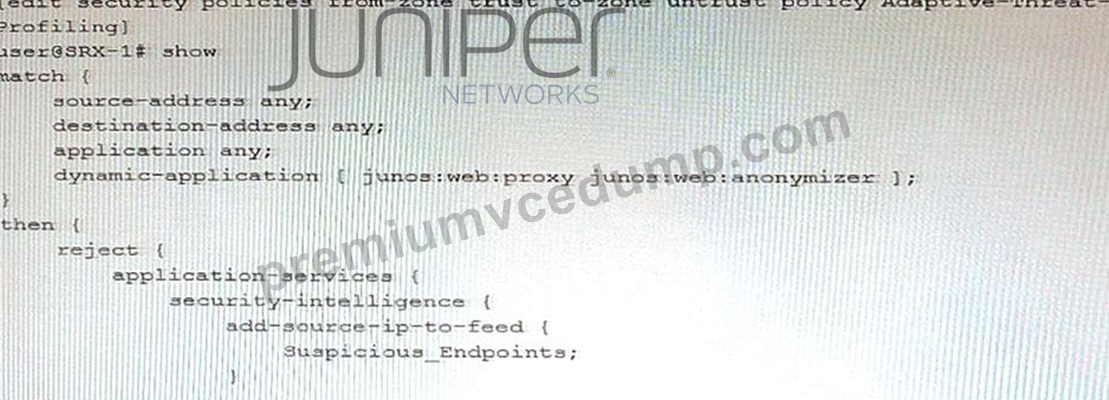
Referring to the exhibit, which two statements are true? (Choose two.)
- A. The 3uspicious_Endpoint3 feed is only usable by the SRX-1 device.
- B. You must manually create the suspicious_Endpoint3 feed in the Juniper ATP Cloud interface.
- C. Juniper ATP Cloud automatically creates the 3uopi'cioua_Endpoints feed after you commit the security policy.
- D. The 3uspiciou3_Endpoint3 feed is usable by any SRX Series device that is a part of the same realm as SRX-1
Answer: A,D
NEW QUESTION # 21
Exhibit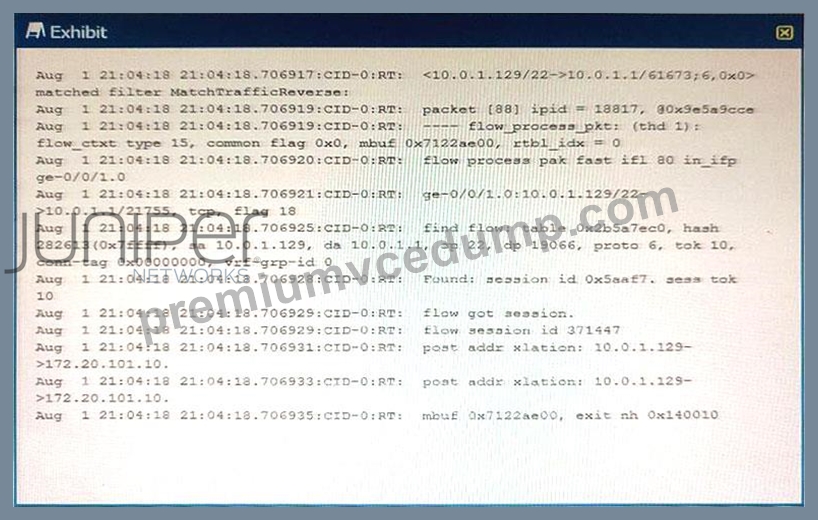
You are using traceoptions to verity NAT session information on your SRX Series device Referring to the exhibit, which two statements are correct? (Choose two.)
- A. The SRX device is changing the source address on this packet from
- B. This is the first packet in the session
- C. This packet is part of an existing session.
- D. The SRX device is changing the destination address on this packet 10.0.1 1 to 172 20.101.10.
Answer: B,D
NEW QUESTION # 22
You are asked to deploy filter-based forwarding on your SRX Series device for incoming traffic sourced from the 10.10 100 0/24 network in this scenario, which three statements are correct? (Choose three.)
- A. You must create a VRF-type routing instance.
- B. You must create and apply a firewall filter that matches on the source address 10.10.100.0/24 and then sends this traffic to your routing
- C. You must create a RIB group that adds interface routes to your routing instance.
- D. You must create and apply a firewall filter that matches on the destination address 10 10.100.0/24 and then sends this traffic to your routing instance.
- E. You must create a forwarding-type routing instance.
Answer: B,C,E
NEW QUESTION # 23
You want to enroll an SRX Series device with Juniper ATP Appliance. There is a firewall device in the path between the devices.
In this scenario, which port should be opened in the firewall device?
- A. 0
- B. 1
- C. 2
- D. 3
Answer: C
NEW QUESTION # 24
Exhibit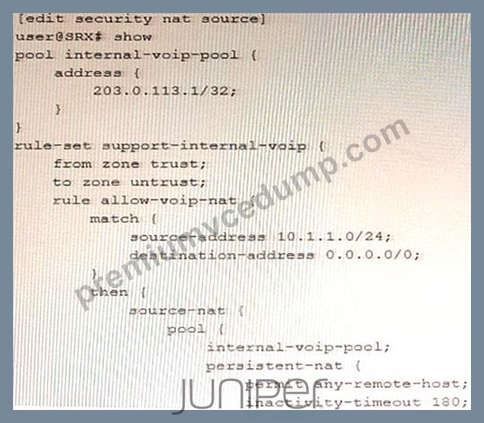
Referring to the exhibit, an internal host is sending traffic to an Internet host using the 203.0.113.1 reflexive address with source port 54311.
Which statement is correct in this situation?
- A. Only the Internet host that the internal host originally communicated with can initiate traffic to reach the internal host using the 203.0 113.1 address, a random source port, and destination port 54311.
- B. Any host on the Internet can initiate traffic to reach the internal host using the 203.0.113.1 address, a random source port, and destination port54311.
- C. Any host on the Internet can initiate traffic to reach the internal host using the 203.0.113.1 address, source port 54311, and a random destination port.
- D. Only the Internet host that the internal host originally communicated with can initiate traffic to reach the internal host using the 203.0.113.1 address, source port 54311, and a random destination port.
Answer: C
NEW QUESTION # 25
Exhibit
Your company recently acquired a competitor. You want to use using the same IPv4 address space as your company.
Referring to the exhibit, which two actions solve this problem? (Choose two)
- A. Configure IPsec Transport mode.
- B. Connect the competitor network using IPsec policy-based VPNs.
- C. Identify two neutral IPv4 address spaces for address translation.
- D. Configure static NAT on the SRX Series devices.
Answer: B,D
NEW QUESTION # 26
Which method does an SRX Series device in transparent mode use to learn about unknown devices in a network?
- A. LLDP-MED
- B. RSTP
- C. IGMP snooping
- D. packet flooding
Answer: D
NEW QUESTION # 27
Your company uses non-Juniper firewalls and you are asked to provide a Juniper solution for zero-day malware protection.
Which solution would work in this scenario?
- A. Juniper Security Director
- B. Juniper ATP Cloud
- C. Juniper ATP Appliance
- D. Juniper Secure Analytics
Answer: B
NEW QUESTION # 28
Exhibit
Referring to the exhibit, which type of NAT is being performed?
- A. Destination NAT
- B. Static NAT
- C. Persistent NAT
- D. Source NAT
Answer: D
NEW QUESTION # 29
To analyze and detect malware, Juniper ATP Cloud performs which two functions? (Choose two.)
- A. static analysis: to see what happens if you execute the file in a real environment
- B. dynamic analysis: to see what happens if you execute the file in a real environment
- C. cache lookup: to see if the file is seen already and known to be malicious
- D. antivirus scan: with a single vendor solution to see if the file contains any potential threats
Answer: B,C
NEW QUESTION # 30
You are asked to look at a configuration that is designed to take all traffic with a specific source ip address and forward the traffic to a traffic analysis server for further evaluation. The configuration is no longer working as intended.
Referring to the exhibit which change must be made to correct the configuration?
- A. Apply the filter as in input filter on interface xe-0/2/1.0
- B. Apply the filter as in output filter on interface xe-0/1/0.0
- C. Create a routing instance named default
- D. Apply the filter as in input filter on interface xe-0/0/1.0
Answer: D
NEW QUESTION # 31
Exhibit: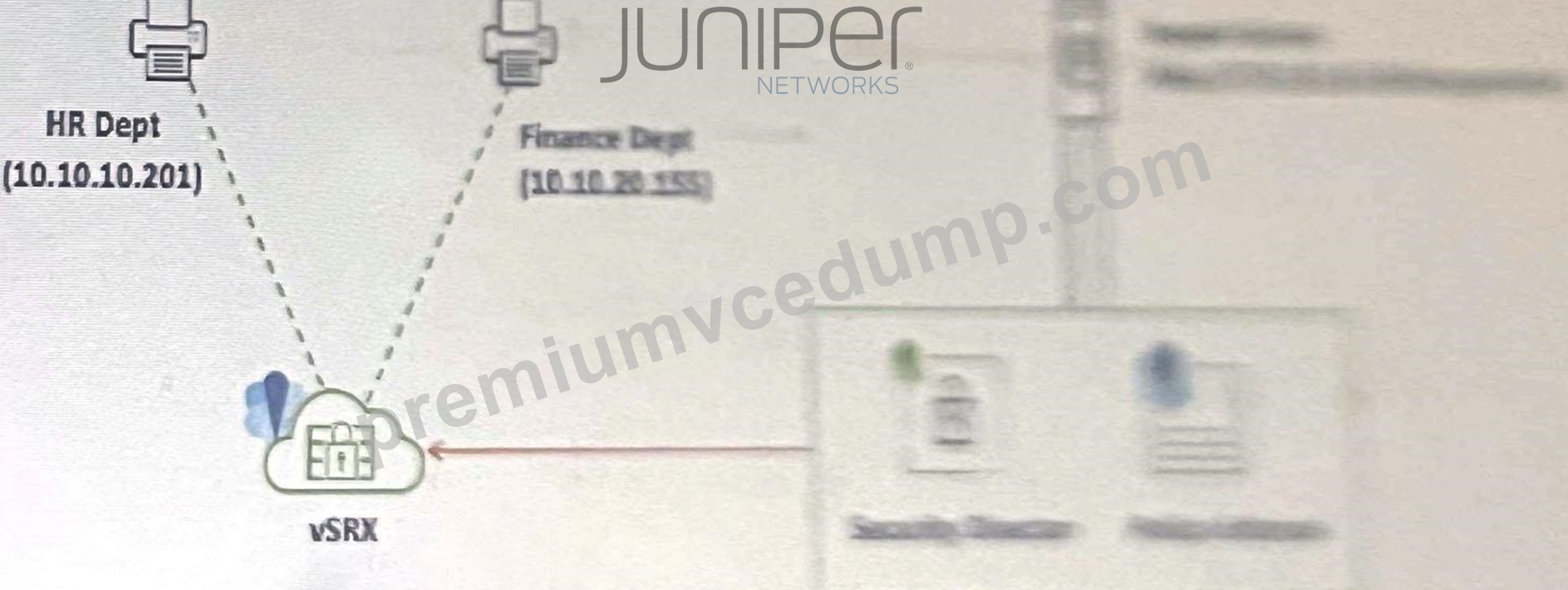
Referring to the exhibit, your company's infrastructure team implemented new printers. To make sure that the policy enforcer pushes the updated Ip address list to the SRX.
Which three actions are required to complete the requirement? (Choose three)
- A. Configure Security Director to create a dynamic address feed
- B. Create a security policy that uses the dynamic address feed to allow access
- C. Configure server feed URL as https://172.25.10.254/myprinters.
- D. Configure Security Director to create a C&C feed.
- E. Configure the server feed URL as http://172.25.10.254/myprinters
Answer: A,B,E
Explanation:
Referring to the exhibit, your company's infrastructure team implemented new printers. To make sure that the policy enforcer pushes the updated IP address list to the SRX, you need to perform the following actions:
A) Configure the server feed URL as http://172.25.10.254/myprinters. The server feed URL is the address of the remote server that provides the custom feed data. You need to configure the server feed URL to match the location of the file that contains the IP addresses of the new printers. In this case, the file name is myprinters and the server IP address is 172.25.10.254, so the server feed URL should be
http://172.25.10.254/myprinters1.
B) Create a security policy that uses the dynamic address feed to allow access. A security policy is a rule that defines the action to be taken for the traffic that matches the specified criteria, such as source and destination addresses, zones, protocols, ports, and applications. You need to create a security policy that uses the dynamic address feed as the source or destination address to allow access to the new printers. A dynamic address feed is a custom feed that contains a group of IP addresses that can be entered manually or imported from external sources. The dynamic address feed can be used in security policies to either deny or allow traffic based on either source or destination IP criteria2.
C) Configure Security Director to create a dynamic address feed. Security Director is a Junos Space application that enables you to create and manage security policies and objects. You need to configure Security Director to create a dynamic address feed that contains the IP addresses of the new printers.
You can create a dynamic address feed by using the local file or the remote file server option. In this case, you should use the remote file server option and specify the server feed URL as
http://172.25.10.254/myprinters3.
The other options are incorrect because:
D) Configuring Security Director to create a C&C feed is not required to complete the requirement. A C&C feed is a security intelligence feed that contains the IP addresses of servers that are used by malware or attackers to communicate with infected hosts. The C&C feed is not related to the new printers or the dynamic address feed.
E) Configuring the server feed URL as https://172.25.10.254/myprinters is not required to complete the requirement. The server feed URL can use either the HTTP or the HTTPS protocol, depending on the configuration of the remote server. In this case, the exhibit shows that the remote server is using the HTTP protocol, so the server feed URL should use the same protocol1.
Reference: Configuring the Server Feed URL Dynamic Address Overview Creating Custom Feeds
[Command and Control Feed Overview]
NEW QUESTION # 32
You are required to secure a network against malware. You must ensure that in the event that a compromised host is identified within the network.
In this scenario after a threat has been identified, which two components are responsible for enforcing MAC-level infected host?
- A. Policy Enforcer
- B. SRX Series device
- C. EX Series device
- D. Juniper ATP Appliance
Answer: A,C
Explanation:
You are required to secure a network against malware. You must ensure that in the event that a compromised host is identified within the network, the host is isolated from the rest of the network.
In this scenario, after a threat has been identified, the two components that are responsible for enforcing MAC-level infected host are:
C) Policy Enforcer. Policy Enforcer is a software solution that integrates with Juniper ATP Cloud and Juniper ATP Appliance to provide automated threat remediation across the network. Policy Enforcer can receive threat intelligence feeds from Juniper ATP Cloud or Juniper ATP Appliance and apply them to the security policies on the SRX Series devices and the EX Series devices. Policy Enforcer can also enforce MAC-level infected host, which is a feature that allows you to quarantine a compromised host by blocking its MAC address on the switch port. Policy Enforcer can communicate with the EX Series devices and instruct them to apply the MAC-level infected host policy to the infected host1.
D) EX Series device. EX Series devices are Ethernet switches that can provide Layer 2 and Layer 3 switching capabilities and security features. EX Series devices can integrate with Policy Enforcer and Juniper ATP Cloud or Juniper ATP Appliance to provide automated threat remediation across the network. EX Series devices can support MAC-level infected host, which is a feature that allows them to quarantine a compromised host by blocking its MAC address on the switch port. EX Series devices can receive instructions from Policy Enforcer and apply the MAC-level infected host policy to the infected host2.
The other options are incorrect because:
A) SRX Series device. SRX Series devices are high-performance firewalls that can provide Layer 3 and Layer 4 security features and integrate with Juniper ATP Cloud or Juniper ATP Appliance to provide advanced threat prevention. SRX Series devices can receive threat intelligence feeds from Juniper ATP Cloud or Juniper ATP Appliance and apply them to the security policies. However, SRX Series devices cannot enforce MAC-level infected host, which is a feature that requires Layer 2 switching capabilities and is supported by EX Series devices3.
B) Juniper ATP Appliance. Juniper ATP Appliance is a hardware solution that provides advanced threat prevention by detecting and blocking malware, ransomware, and other cyberattacks. Juniper ATP Appliance can analyze the network traffic and identify the compromised hosts based on their behavior and communication patterns. Juniper ATP Appliance can also send threat intelligence feeds to Policy Enforcer and SRX Series devices to enable automated threat remediation across the network. However, Juniper ATP Appliance cannot enforce MAC-level infected host, which is a feature that requires Layer 2 switching capabilities and is supported by EX Series devices.
Reference: Policy Enforcer Overview EX Series Switches Overview
SRX Series Services Gateways Overview [Juniper ATP Appliance Overview]
NEW QUESTION # 33
......
Pass Your JNCIP-SEC JN0-637 Exam on Dec 20, 2024 with 117 Questions: https://www.premiumvcedump.com/Juniper/valid-JN0-637-premium-vce-exam-dumps.html
Latest Juniper JN0-637 PDF and Dumps (2024) Free Exam Questions Answers: https://drive.google.com/open?id=1tVtXKa3JhXQfuXu9fHcxfb85DUOYV9gC